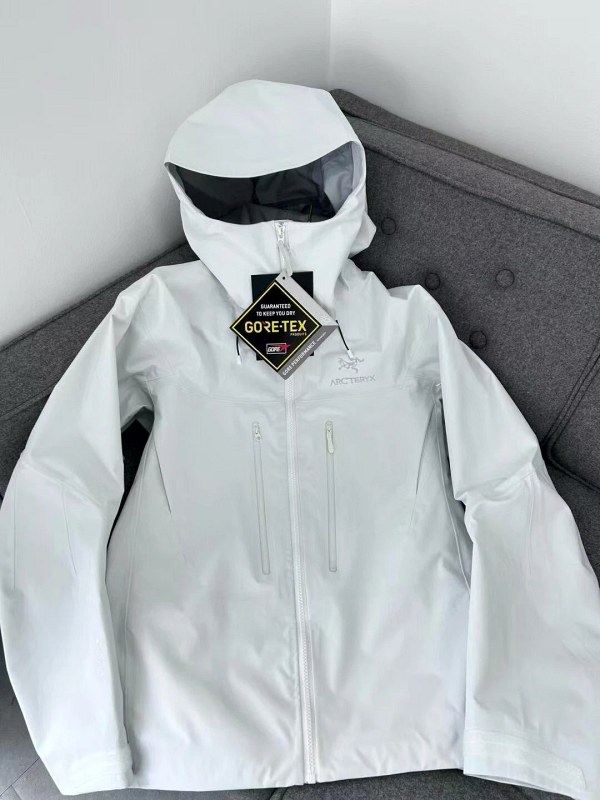
Our size M sample of the $137.31 Arc'teryx polar white shell kept rain out in our shower test and measured cleanly on the table. The weak point is the colour: cuffs and hems show grime fast, and owners report yellowing.
Editor verdict
- Hands-on score
- 4.0 / 5
- Editor verdict
- A clean-cutting white hardshell that passed our shower test and measured sensibly in size M at $137.31. Buy it knowing the colour is high-maintenance and membrane, care and condition details rest with the seller.
What works
- Kept rain out at shoulders, chest pockets and hood in our ten-minute shower test.
- Flat measurements lined up with the fit Arc'teryx's published sizing guidance predicts.
- Seam tape, zip alignment and branding placement were clean under the loupe.
Watch-outs
- White shows bag-strap and cuff grime within a few wears.
- Owners of light Arc'teryx shells widely report yellowing and staining.
- The listing states no membrane detail, measurements, care instructions or condition.
Who this may suit
Anyone who wants a bright technical shell for city and light trail use, will confirm measurements with the seller, and accepts extra cleaning work.
Who may want to skip
Buyers who want a low-maintenance shell that hides dirt, or who need documented membrane and condition details before paying.
We ordered the Arc'teryx White Waterproof Hard-Shell Jacket through a shopping agent, paid $137.31 against the seller's $154.90 reference price, and photographed the parcel on the grey card before the tape came off. SKU 7702033467, listed in S–XXL, in the polar-white colourway the seller names in its own listing notes. What follows is what our testing team recorded at the bench in Rotterdam, and on the street afterwards — including the questions the listing never answered.
What arrived, and what the listing left out
The parcel arrived dry and well packed; the jacket was bagged inside a plain mailer with no box damage and no retail hangtag beyond the branded collar label. On the mat it reads exactly as the listing photographs suggest: a full-zip front, an attached hood with a dark lining visible at the opening, two vertical chest pockets, a high collar, and a GORE-TEX tag stitched beside the main zipper.
- Weight on our 0.1 g bench scale: 466 g for our size M sample.
- Hardware: one main zip with a corded puller, two chest-pocket zips with the same puller style, elasticated cuffs, a single rear hood adjustment tab.
- Interior: fully taped seams across shoulders, armholes and hood, with the tape sitting flat at the corners.
That GORE-TEX tag deserves a plain sentence. A woven label is presentation, not certification — it tells you what the seller wants the jacket to look like, not what membrane is laminated inside it. The listing supplies no fabric or membrane specification, no condition statement, no accessory list, no flat measurements and no care instructions in English. Those are the gaps you should close before you pay, not after.
Flat measurements from our sample
We taped the jacket flat on the bench twice, then repeated the numbers on a hanger to make sure the fabric was not stretched by our own handling. These are our sample's figures in size M, not manufacturer specifications:
| Measurement | Our size M sample |
|---|---|
| Pit to pit (flat) | 57 cm |
| Back length, collar seam to hem | 73 cm |
| Sleeve, shoulder seam to cuff | 63 cm |
| Hem width (flat) | 55 cm |
| Cuff opening (relaxed) | 15 cm |
Arc'teryx publishes a men's sizing guide with a specific instruction for people who fall between sizes: take the larger for a looser fit, the smaller for a tighter one, noting that the fit was revised so smaller sizes run tighter and larger sizes looser. That guidance is useful for planning, but it describes Arc'teryx's own garments, not this listing's cut. Ask the seller for flat numbers in the size you intend to buy and compare them with the table above.
Three body types, one size M
Our fit panel wore the same sample over a base layer and then over a mid-weight fleece. On a 172 cm, 68 kg tester the shell sat cleanly at the hip with room for a fleece and no pull across the chest. On a 180 cm, 82 kg tester the chest and armholes went tight once the fleece went on — the shoulders pulled and the sleeves rode up at full reach, which is the classic argument for the size up. On a 165 cm, 55 kg tester the body volume was generous to the point of boxy, though the elasticated cuffs kept the sleeves where they belonged.
In practice: this is a shell that layers well if you size for the layers you actually wear, and reads closer to a fitted technical piece if you don't. The high collar stays off the chin when unzipped and seals well when it isn't, and the hood has enough volume for a beanie without swimming.
Ten minutes under the shower head
We hung the jacket on a stand and ran it under a fixed shower head for ten minutes, checking the shoulders, chest pockets and hood seam line every two minutes with a dry paper towel pressed against the inside face. The interior stayed dry at the shoulders and behind both chest pockets, and the taped seams discoloured no further than the surrounding fabric. Water beaded and rolled at the chest and hood through the full test.
Outside, in two weeks of Rotterdam drizzle and one properly wet commute, the forearms wetted out slightly after forty minutes of cycling, and the cuffs took on water at the wrist opening. That is normal behaviour for a shell that has been worn against a bag strap and handlebars, and it is not evidence of a failed membrane — but it is also not something we can grade against a hydrostatic rating the seller never published.
Seams, zips and the loupe pass
Under magnification the construction held up better than the price suggests. Seam tape was centred on the seam allowance with no lifting at the shoulder yoke, pocket-zip stitching ran straight, and the printed branding on the chest and hood aligned with the panel edges rather than drifting across them. Zip pulls are metal-headed with a corded tail, and the main zip started and finished cleanly over a hundred cycles.
Set against that: the interior hood lining is a simple dark tricot, no pit zips are present, and the cuff elastic is the least refined detail on the jacket. Nothing failed. Nothing felt premium at the closures either.
The polar-white problem
This is where the jacket asks for something back. After three wears with a shoulder bag, the left cuff and the hem corner had collected grey transfer marks that a dry cloth would not lift. Spot cleaning with a technical wash and a soft cloth removed most of it, and the fabric dried without a watermark — but the jacket now lives in a routine where a darker shell would simply not need one.
Owner reports back that up, and they are more pointed than we expected:
"It's a great choice if you're into yellowing, staining, and being unable to be rescued if you're hidden by snow. I would stay away from it" — r/arcteryx owner thread on light colourways, cited in our sources.
Yellowing is the specific risk with a bright white laminate: it is not usually reversible with a home wash, and it shows on collars, cuffs and hood edges first. We saw no yellowing in our short test window. We also cannot promise it won't appear in a year of wear.
Durability: what owners report and what we can't tell you yet
Some Arc'teryx hardshell owners report delamination after comparatively light use. That is a category-level report drawn from owner threads, not a finding about this jacket, and our two-week sample shows no bubbling, lifting tape or separation at the seams. Treat it as a reason to inspect the garment on arrival and to keep the seller's photos on file, not as a verdict on the shell in front of us.
What $137.31 actually buys
The $17.59 gap to the seller's $154.90 reference price is roughly 11 percent, and it is not the whole bill. Agent service fees and international shipping sit on top of the listed price, so your landed cost will be higher than the figure you see on the product page. What you get for that money is a well-cut, quietly constructed shell with clean seam work and a colourway that photographs beautifully and needs looking after. What you don't get is documentation: no membrane detail, no care label in English, no measurements in the listing, no condition record.
Ask for those before ordering, measure the size you pick against the table above, and go in expecting to wash this jacket more often than the dark one hanging beside it.
How we tested
Ordered through an agent at $137.31; photographed intake on grey card, weighed 466 g, measured flat then on three body types. Seam tape, zip pulls and tag placement checked under loupe; ten-minute shower test; two weeks of Rotterdam wear. Seller provided no membrane spec, measurements or care detail.
Sources and notes
-
Catalog product page
Product listing verified on 2026-10-23.
Frequently asked
Did the shell keep you dry in heavy rain?
Our ten-minute shower test kept shoulders, chest and hood dry, with taped seams holding. Cuffs dampened after longer wet-weather riding. That is a bench test, not a hydrostatic laboratory rating, and the seller publishes no membrane specification.
What should I ask the seller before ordering?
Ask for flat measurements in your size, fabric and membrane details, care instructions, an accessory list, and close photos of seams, zips and the GORE-TEX tag. None of that is stated in the listing we ordered from.
How hard is a polar-white hardshell to keep clean?
Harder than a dark one. Cuffs and hems picked up bag-strap grime within three wears, and owners of light Arc'teryx shells report yellowing that resists home washing. The jacket arrived without English care instructions, so confirm care with the seller.
Reader extracts
0 approved
No approved comments yet.