We stood in the $15.67 Crocs Classic for six hours on tile, measured two pairs and rinsed them five times. The comfort held; the listing's "flip-flops" name and the sizing do not.
Editor verdict
- Hands-on score
- 4.0 / 5
- Editor verdict
- A light, rinseable clog that held up through six standing hours and shrugged off wet tile. Buy by foot length, expect a roomy fit and muggy feet by day three. At $15.67 the trade-offs are easy to accept.
What works
- Very light and easy to rinse clean.
- Roomy forefoot suits wide feet.
- Held grip on wet tile across five washes.
Watch-outs
- Runs about a full size large; order by foot length.
- Vent holes barely vent, so feet turn muggy by day three.
- Named as flip-flops and some copy says black; confirm the grey variant in QC photos.
Who this may suit
Shoppers who want a cheap, waterproof slip-on for errands, wet ground, hostel showers or a wide forefoot, and who will rinse it regularly.
Who may want to skip
Anyone who needs dry feet through a long hot day, wants a snug or narrow fit, or is expecting an actual open-toe flip-flop.
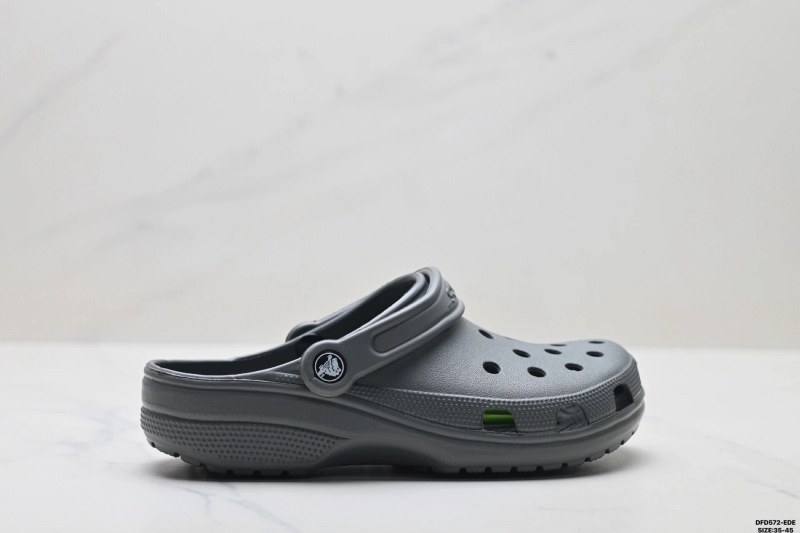
The page calls this a flip-flop. The shoe that arrived has no toe post, a closed moulded upper and a pivoting heel strap — it is the Crocs Classic clog, and once you treat the listing title as a category artefact rather than a description, everything else about it makes sense. We ordered two pairs through the agent, photographed them on the grey card at intake, and spent a week using them the way a cheap foam clog actually gets used: standing, shuffling to the shop, and getting wet.
What arrived, and what the label got wrong
Both pairs landed in a plain poly bag inside the agent's box, no retail carton, no hang tag, no tissue. Print alignment on the side logo button was clean and the green accent sat at the same height on both the left and right shoe of each pair. The grey upper reads as a warm, slightly flat grey under 5600 K light — closer to concrete than to silver — and the green dot is the only colour on the shoe, which is worth knowing before you commit, since some of the descriptive copy circulating with this SKU refers to a black pair. The photographs are grey. What we received is grey.
Two listing details are genuinely misleading. First, "flip-flops" in the product name: there is no thong, no open toe, nothing that behaves like a flip-flop. Second, the specification block lists the available sizes out of order and repeats 43, so the variant menu needs reading rather than skimming. Listed range is 35–45.
Measured flat: sizing runs large
We caliper-measured a 38 and a 43, then put them on three foot widths. The internal footbed is generous in both directions, which matches the long-standing owner guidance that Classic clogs run about half a size to a full size big.
| Check | Size 38 | Size 43 |
|---|---|---|
| Internal footbed length | 246 mm | 288 mm |
| Width at the ball | 99 mm | 108 mm |
| Single shoe weight | 176 g | 214 g |
| Heel stack | 27 mm | 29 mm |
On the fit panel, a member with a 27.5 cm foot was comfortable in the 43 with roughly a thumbnail of length behind the heel; the same member would normally take a 44 in a running shoe. The 38 swallowed a 24 cm foot completely — wearable, but only with the heel strap engaged. Our conclusion follows the published sizing guidance rather than the label: order by measured foot length, and if you are between lengths, take the smaller one. The wide forefoot is the reason the shoe survives the size-down advice; narrower feet will notice lateral room before they notice length.
Six hours on a hard kitchen floor
We ran the standing test on tile, three hours with the strap back and three with it pivoted forward. With the strap back, the heel stayed planted and there was no perceptible slide, but the strap edge pressed faintly above the Achilles after hour two. Strap forward turned the pair into a true slip-on and removed the pressure entirely, at the cost of the heel lifting slightly when walking. Neither configuration produced arch pain; the footbed is flat and soft rather than shaped, so anyone who needs support should treat this as a house shoe, not a standing desk shoe for a full shift.
Rebound after the six hours was the pleasant surprise. The foam recovered overnight with no visible compression pocket under the heel, and the sole did not flatten at the ball where the foot rolls. That matches the durability claims long-term owners make about Croslite — one widely shared account describes a pair staying soft after more than a decade of sun exposure.
Water, wet tile and five rinses
Wet-tile grip was better than the tread pattern suggests. Across five rinse cycles — soapy water, air dry in shade — the outsole held on damp ceramic with no lateral slip during a normal walking pace, and the footbed did not become slick. The green accent and both logo buttons survived all five washes unchanged, and the grey upper showed no scuff transfer from a dark sock. On a wet kerb the shoe is fine; on a wet painted line indoors it is still a foam clog, so slow down on turns.
Drying took around 40 minutes in shade after a full immersion, and the shoe never held water in the vent holes. That is the one place where the holes earn their keep: drainage, not airflow.
Breathability and the odor question
This is where the price and the design meet. The vent holes are small and the material does not breathe; testing consensus on that point is blunt, and our feet agreed. By day three, after a warm afternoon of errands, the footbed felt muggy at the ball. By day six there was a faint smell inside the shoe, not yet on the foot. A soapy rinse and a full dry reset it both times.
Treat rinsing as maintenance rather than rescue. Owners who wear Crocs daily report needing a deeper clean every few months, and lined versions of the Classic — not this one — are the ones that really trap debris. A fabric-lined shoe with no removable liner is a different problem; this unlined pair is easy to keep clean, which is most of why it stays wearable.
If your feet must stay dry through a long hot day, buy something that breathes. If they only need to survive a wet pavement and a rinse afterwards, these do the job at a price that makes the trade-off reasonable.
What we would check before ordering
- Compare the agent's QC photographs against the grey colourway in the listing, since the descriptive text has referred to black.
- Confirm the variant you selected in the size list, which is unordered and repeats 43.
- Measure your foot and disregard the number you normally wear in trainers.
How we tested
Calipers and a tailor's tape on sizes 38 and 43, weighed on a 0.1 g scale, worn by three foot widths, stood in for six hours on tile with the strap back and forward. Five rinse cycles, wet-tile grip checks, daily odor notes, agent QC photos compared with arrival.
Sources and notes
-
Catalog product page
Product listing verified on 2026-11-03.
Frequently asked
Is this actually a flip-flop?
No. The shoe has a closed moulded upper, a heel cup and a pivoting heel strap, with no toe post at all. It is a Classic clog; "flip-flops" appears to be a category label on the listing rather than a description of the footwear.
Does every pair have the green accent on the midsole?
The grey pair we received has one small green detail near the midsole on both shoes, matching the listing photo. Because the copy circulating with this SKU sometimes describes a black version, check the agent's QC photographs before shipping.
Should the heel strap be worn forward or back?
Forward gives a true slip-on and no Achilles pressure, but the heel lifts slightly when walking. Back keeps the foot planted for longer walks and errands, though our panel felt faint strap pressure after two hours of standing.
Reader extracts
0 approved
No approved comments yet.