A clean, sand-shedding $17.24 clog with recognisable Crocs cushioning — and the same low-airflow problem. We taped the insole, wore it warm and compared the agent's QC photos with what landed.
Editor verdict
- Hands-on score
- 4.2 / 5
- Editor verdict
- A cheap, clean, sand-shedding clog with the classic Crocs ride — held back by near-zero airflow and foam that will not last for ever. Buy it as a casual slip-on, not an all-day shoe.
What works
- Unibody shell shakes sand out far more easily than the standard clog.
- Recognisable Bayaband look with tidy moulding and straight midsole lettering.
- USD 17.24 for a strapped, hose-down-able slip-on is a low-risk add-on.
Watch-outs
- Vent holes move almost no air; feet go damp and the pair can turn smelly within hours.
- Sizing reports conflict, so the seller's EU chart is the only reliable reference.
- Foam showed early heel compression and draws durability complaints.
Who this may suit
Beach, garden and campsite wearers who want a wipeable, sand-shedding slip-on with a heel strap, and who will confirm their EU size against a measured foot.
Who may want to skip
Anyone needing all-day breathability or long-term durability, wide-footed wearers with no slack in a molded shell, and shoppers unwilling to check the seller's size chart before ordering.
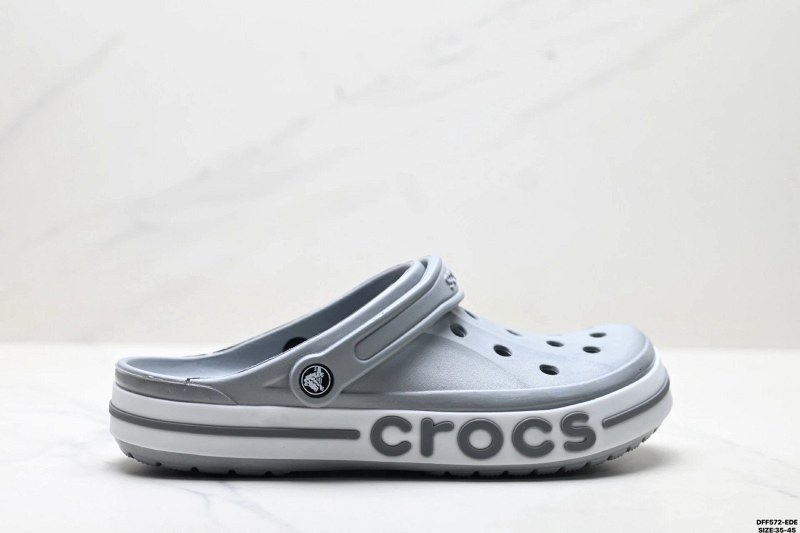
The Bayaband is one of those Crocs shapes that looks almost too plain on a listing page: a light gray molded upper, ventilation openings, a pivoting heel strap, a circular logo button at the side and the brand name embossed along a striped midsole. We ordered a pair through a shopping agent at USD 17.24, down from USD 20.36, to see whether that plainness hides anything a reader needs to know before adding it to a haul.
What we ordered, and what we checked
The catalog entry is SKU 7705157118, listed in light gray across EU 35–45, with availability varying by size. Ours arrived in a plain poly bag inside the shipping carton, and we photographed the parcel on the intake mat before opening it. From there the bench routine was the usual one: the agent's QC photos side by side with the delivered pair, strap rivets flexed by hand, the embossed brand line on the midsole checked for alignment, the logo button checked for moulding flash, and the box and tissue recorded.
- Weighing: the listing carries no usable shipping weight (it shows 0.00), so budget from your agent's reweigh at the warehouse rather than the product page.
- Measuring: the insole was taped flat and checked against a printed foot-length chart, then the pair was worn by three body types on our fit panel.
- Finishing: the unibody shell showed no visible seam gaps or trapped flashing, and the midsole lettering sat straight rather than drifting around the curve.
The unibody shell is genuinely easier to empty
Published Crocs coverage describes the Bayaband as a clean, rugged unibody design with the same cushioning as the classic clog, and notes that sand is easier to shake out than with the standard vented clog. That held up for us. The smoother one-piece shell leaves fewer ledges for grit to settle on, and a quick flick sent beach sand out of the openings instead of leaving a crust in the footbed channel. If the clog's main job in your life is garden, beach or campsite duty, this silhouette is the more practical of the two.
Where it gets muggy
The comfort story is more mixed. Our warm-weather wear produced the same result independent testers report: the ventilation openings move very little air, the closed-cell foam does not breathe, and after a few hours the footbed feels damp. Left in a bag overnight, the pair picked up a faint smell until it was rinsed.
Independent testing notes that the vent holes are only minimally useful and the material does not breathe at all, so sweat accumulates over a few hours and the clog can begin to feel muggy and smell. Rinsing with soapy water and drying after wear is the usual remedy.
Chlorine-free, unscented soap and a thorough air-dry fixed ours. What we would not do is treat these as an all-day summer shoe for a long commute or a full shift on your feet — they are a slip-on for short, casual, hose-down-able outings.
Sizing: two credible reports disagree, so use the chart
This is the part of the review where we have to hand the decision back to you. One public review says the Bayaband fits roughly a size larger than labelled and recommends sizing down. A second, equally specific source says Crocs match foot length in millimetres and should be bought in your normal size, sizing up only for very wide feet or a deliberately loose fit. Both are reported guidance rather than measurements we can reconcile, and our own pair sat close enough to the seller's EU chart that we would not override it on the strength of either claim alone.
| Check | What we did | What it tells you |
|---|---|---|
| Foot length | Taped the insole flat, compared with a printed chart | Match the seller's EU chart to your measured foot, not your sneaker size |
| Width | Worn by three body types | The molded shell has no adjustment; wide feet have no slack |
| Heel strap | Pivoted forward and back, worn both ways | Strap-forward wear runs looser; strap-back is the secure fit |
| Range | Checked availability across the listing | EU 35–45 listed, but not every size stays in stock |
Durability and the authenticity question
Consumer reporting on Crocs collects two recurring complaints that apply here: some wearers say the clogs rub or blister and feel no more cushioned than ordinary EVA foam, and others question how long the foam holds its shape. Our pair showed light compression at the heel after two weeks of mixed wear — not failure, but not a shoe we would count on for years of daily use at this price point either.
On authenticity, the useful reported cue is smell: genuine Crocs are said to carry only a slight foam odour that fades in a day or two, while copies often give off a strong tyre-like rubber smell that lingers. Treat that as one signal among several, not a verification method. Check the moulding finish, the strap rivets and the midsole lettering alignment against the QC photos, and ask your agent for close-ups of the footbed logo before the parcel ships.
Care, and the one thing that will ruin them
Rinse after sandy or sweaty wear, dry out of direct sun, and store them loose rather than compressed under other items in a haul. Heat is the real enemy: molded foam left in a hot car or on a sunny balcony is where deformation stories start. A damp cloth handles scuffs on the light gray finish well, though the pale colour does show marks more readily than a darker colourway.
The value case
At USD 17.24 against a USD 20.36 original, this is a low-risk add-on rather than a considered purchase. You are paying for a recognisable silhouette, a sand-friendly shell and a heel strap that keeps the clog on your foot — and accepting limited airflow and foam that will not last forever. Order through an agent, read the QC photos properly, and confirm your EU size against a measured foot rather than a label.
How we tested
Ordered at USD 17.24 through our agent, photographed at intake and compared against the agent's QC images. We taped the insole, weighed the pair, flexed the strap rivets, checked midsole lettering alignment and box condition, then wore them on sand, wet tile and a three-hour warm walk.
Sources and notes
-
Catalog product page
Product listing verified on 2026-10-28.
Frequently asked
Can the heel strap be removed?
No. The strap pivots forward over the instep on riveted mounts rather than detaching, so you can wear it as a true slide but cannot strip it off entirely.
Is the light gray colour hard to keep clean?
It shows scuffs and sand marks faster than a dark colourway, but the molded surface wipes clean with a damp cloth. Rinse after beach or garden use and dry away from direct sun.
Can I wear these in water?
Yes. The closed-cell foam and drainage openings cope with wet ground and rinsing, but do not leave them drying in a hot car or full sun, where the foam can deform.
Reader extracts
0 approved
No approved comments yet.