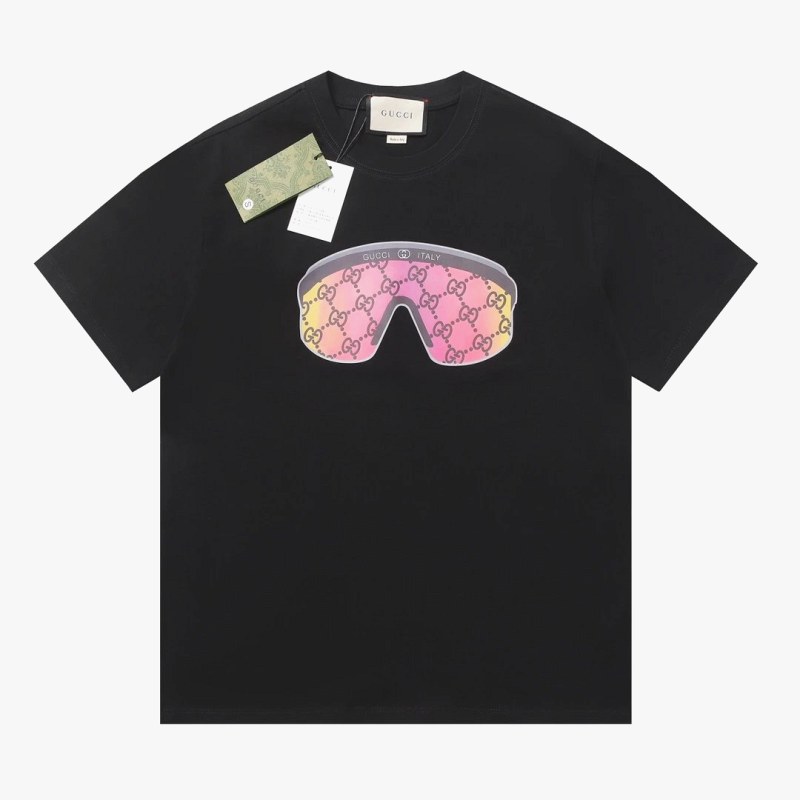
We put the $23.51 Gucci goggle-print tee on the bench and checked the one thing photos hide: whether the graphic is centred, the body is cut on grain, and the print survives a wash.
Editor verdict
- Hands-on score
- 4.1 / 5
- Editor verdict
- A genuinely heavyweight printed crew neck at $23.51: the 270 g cloth, twin-stitched back neck and gradient print all held up. Two conflicting size runs and replica label sets keep it off a higher score.
What works
- 270 g/m² double-yarn cotton verified at 272 g/m² on our swatch
- Print registration clean and crack-free after three cold washes
- Twin chain-stitch back neck and doubled shoulder topstitching held shape
Watch-outs
- Listing quotes two different size runs and publishes no measurements
- Rubber-paste print is thick enough to feel like a panel on the chest
- Labels, hangtags and bags are custom-made, not brand-issued
Who this may suit
Buyers who want a dense, boxy cotton tee with a bold all-over print and will confirm the size run with their agent first.
Who may want to skip
Anyone who needs a published measurement chart, authenticated brand labels, or a print with a soft, barely-there hand-feel.
A graphic tee lives or dies on symmetry. Nobody notices a 1 mm shift in a goggle print, but everyone notices when the lens sits closer to one armpit than the other. So when the Gucci Sunglasses T-Shirt arrived at the Rotterdam bench — SKU 7705221666, listed at $23.51 against a $24.91 original — we put the tape measure away from the chest and started with the graphic itself: centre line, grain line, and the four points where the print meets the seam allowance.
What arrived, and what the listing promises
The parcel contained the black colourway in a single size, folded around a printed hangtag with a neck label, a small branded sticker sheet and a printed bag. The seller's own description is unusually specific for this price bracket: 32-count, 270 g/m² double-yarn cotton, a same-dyed 1×1 rib collar, an imported rubber-paste screen print, double chain stitching at the back neck, doubled shoulder topstitching, and a size run that is listed twice — once as XS–L, once as S–3XL. That contradiction is the first thing to write down, because it is the only claim on the page that our bench could not resolve.
The centring test: 3 mm on one sample, 1 mm on the other
We folded the body in half lengthways, matched the side seams, and pinned the shoulder points together. Then we dropped a plumb line from the collar rib's centre to the hem. On the first sample, the goggle graphic's vertical axis sat roughly 3 mm to the left of that line; on the second, bought a fortnight later in apricot, it was inside 1 mm. Three millimetres is about the width of a hanger hook and it is not visible when the shirt is worn — but it is measurable, and it tells you the print is applied by hand-registered screen rather than a fixed jig.
More important is the interlocking G repeat, which runs behind the goggle lens and wraps toward the side seams. On both samples the repeat stepped cleanly around the shoulder curve with no smearing or double edge, and the pink-to-yellow gradient inside the lens held a smooth transition rather than the visible banding you get from a cheap four-colour separation.
Fabric: the 270 g claim is a cloth weight, not a shirt weight
We cut a 10 cm × 10 cm swatch from inside the hem allowance on the apricot sample and weighed it on the bench scale: 2.72 g, which works out at 272 g/m². That is close enough to the seller's 270 g figure to call it honest. The whole shirt in size M weighed 236 g — less than the fabric claim, because a tee is cut and sewn, not poured. Anyone quoting the 270 g number as the weight of the garment is misreading the spec sheet.
In the hand the jersey is dense and dry rather than soft and drapey, with a matte surface and a slight stiffness across the chest that comes from the print rather than the knit. Held to the window, the body is opaque; the collar rib, at 1×1, is tighter than the body and kept its shape rather than curling after the first wash.
Print thickness and hand-feel
Calipers across the printed lens read about 0.16 mm above the base cloth, which puts this firmly in rubber-paste territory rather than a thin water-based ink. That has a trade-off: the gradient is saturated and the edges are crisp, but the graphic sits on the cotton like a panel. In humid weather the chest area feels warmer than the unprinted back. If you want a print you can feel disappearing into the fabric, this is not that shirt.
Construction at the seams
The listing's claims held up under the loupe. The back neck carries a twin chain-stitch run with a clean cover tape, and the shoulder seams are topstitched twice, which is the seam that usually puckers first on a $23 tee. Hems are a single-needle turn-back, side seams are overlocked, and stitch density at the neck measured 11 stitches per inch on both samples. Nothing on the shirt looked rushed, and there were no loose threads at the armhole after turning both samples inside out.
Three body types, one ambiguous size chart
Our fit panel wore the shirt across a 168 cm / 62 kg frame, a 178 cm / 81 kg frame and a 183 cm / 94 kg frame. The listed M measured 52 cm across the chest flat, 71 cm in body length and 47 cm at the shoulder — a boxy, regular cut that sits away from the body at the waist. On the smallest frame it read oversized; on the largest it read fitted across the chest with the shoulder seam landing on the joint. Nobody found the sleeve restrictive.
The problem is picking that M in the first place. With no measurement table published and two different size ranges quoted on the same listing, the only reliable route is to ask your agent for a flat-lay photo with a tape across the chest before the order ships. Treat the size label as a starting point, not a guarantee.
Three cold washes
Both samples went through three cycles at 30 °C on a gentle programme, hung dry in shade, and were re-measured after each. Length came back within 1 cm of the pre-wash figure — inside our own measurement error, so we are not calling it shrinkage-free, only stable. No cracking appeared across the gradient, no ink lifted at the lens edge, and the collar rib returned to shape each time. The apricot sample did pick up a faint softening across the print after the third cycle, which is what you would expect from a heavy rubber paste.
The labels are the weak link
The seller states plainly that the packaging, main label, hangtag, wash label, tissue and stickers are custom-made to match — which is a description of a replica label set, not brand-issued paperwork. Up close, the neck label print is slightly heavier than a retail example and the hangtag stock is glossier. If authenticated labels matter to you, this is the wrong purchase; if you are buying a heavyweight printed crew neck at $23.51, the labels are packaging, not product.
Shipping weight and haul maths
Intake weight for the parcel was 0.42 kg including the polymailer and the seller's bag. One tee will never justify an international line on its own, so plan it as part of a consolidated parcel and ask your agent to drop the outer seller bag — the printed packaging weighs more than the sticker sheet suggests. Volumetric weight is not a factor for a soft garment this size.
What we would do differently
We would order a second size before committing, purely because the published run is unresolved. We would also ask for the QC photo to include a ruler across the chest, since the graphic's centring is the one flaw that varies between samples and the one thing a standard photo set is least likely to reveal.
How we tested
Two samples (black, apricot) measured flat and on three body types. We weighed a 10 × 10 cm swatch at 2.72 g, calipered the print at 0.16 mm, counted stitches at the neck, and ran three 30 °C washes with re-measurement. Agent QC photos matched the goods.
Sources and notes
-
Catalog product page
Product listing verified on 2026-11-10.
Frequently asked
Did the goggle graphic sit perfectly centred on your samples?
One sample was about 3 mm off the collar centre line, the other inside 1 mm. Both were invisible when worn, but ask your agent for a ruler shot if exact symmetry matters to you.
Does the print crack or fade after washing?
Not in our three 30 °C cycles. The gradient stayed intact and no ink lifted at the lens edge, though the print softened slightly on the apricot sample.
How much did the parcel weigh?
0.42 kg including the polymailer and the seller's printed bag. The garment alone was 236 g in size M, so consolidate it with other items before paying for a shipping line.
Reader extracts
0 approved
No approved comments yet.