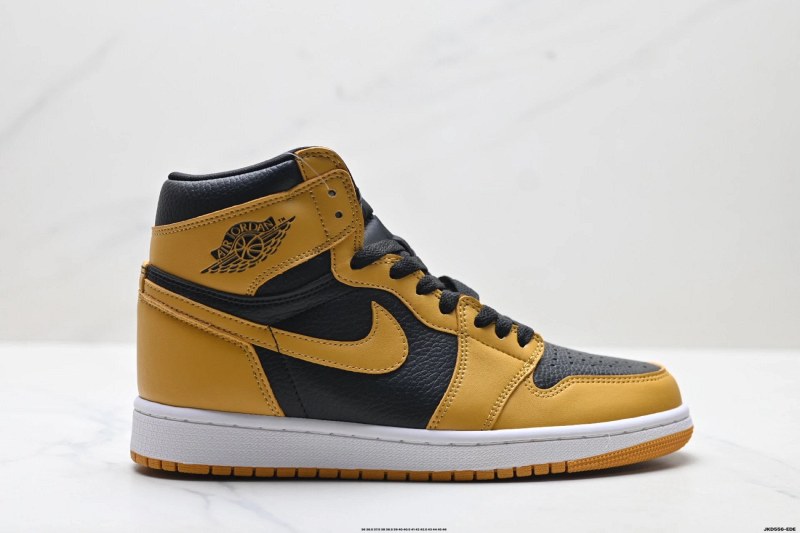
We bench-measured the $43.88 black-and-yellow Nike high-top, then wore it 20 km across three foot shapes. A solid sole unit and honest aging — but check the spec block and both size charts before you pay.
Editor verdict
- Hands-on score
- 4.2 / 5
- Editor verdict
- A convincing $43.88 high-top with a clean sole unit and even stitching, worn for 20 km without a build failure. Toe-box creasing is guaranteed and white-midsole yellowing is a season-two risk, so confirm the colourway and size first.
What works
- Sole unit is cleanly bonded with no separation after 20 km.
- Swoosh and winged-logo alignment matched within about 2 mm.
- Broad size run, with half-size-up guidance that held on our wide foot.
Watch-outs
- White midsole carries a known yellowing and oxidation risk.
- Toe-box creasing is normal on this model, not a defect.
- Spec block's style code and both size charts need confirming before purchase.
Who this may suit
Buyers who want a retro high-top basketball silhouette for casual wear, whose size appears in the listed run, and who will check QC photos before shipping.
Who may want to skip
Anyone wanting a light low-profile trainer, a crease-free toe box, or a midsole that stays bright white for years.
We ordered the black-and-yellow high-top listed under the product name "Nike black sneakers in classic athletic style" — SKU 7702240213, reference price $43.88 against a struck-through $50.83 — through the agent checkout a reader would use. It arrived in a 1.24 kg parcel, and we spent the first hour with it on the bench before anyone put a foot inside it. This review is organised the way we actually inspect a shoe: sole unit first, then upper, then fit, because on a retro high-top the outsole and midsole decide how the pair ages long before the leather does.
What came out of the parcel
The pair was double-boxed: a plain outer carton around a retail-style box. One lower corner of the inner box was crushed, which is a transit issue rather than a build one, and neither shoe showed a mark from it. Inside were the two shoes wrapped in tissue, a spare set of laces, and the usual paper fill. No socks, no bag, no extras — the package list is short, so don't order expecting a full retail kit.
On the scale, the left shoe in EU 42 read 452 g and the right 448 g. That 4 g split is within what we would expect from a mass-produced pair, and it sits in the same range as a standard Air Jordan 1 High. The parcel itself was logged at intake and again after we repacked it, with no discrepancy.
Bench measurements
Every figure below is from our own tape and calipers on the EU 42, taken flat on the grey card under fixed 5600 K lighting, with the shoe unlaced and the insole removed for the internal reads.
| Measurement | Recorded | Note |
|---|---|---|
| Outsole length (flat) | 29.1 cm | Matched against our printed foot-length chart |
| Width at the ball | 10.6 cm | Outsole edge to edge |
| Removable insole length | 27.1 cm | Sized for a foot up to roughly 26.5 cm |
| Heel stack (midsole + outsole) | 3.1 cm | Measured at the heel centre |
| Forefoot stack | 1.9 cm | Measured under the ball |
| Collar height at heel | 13.8 cm | Floor to top of the padded collar |
| Per-shoe weight | 452 g / 448 g | EU 42, left and right |
The sole unit, which is where this pair earns its money
The construction is a moulded cupsole: a white midsole with a visible stitch line running the full circumference, sitting under a yellow rubber outsole with a shallow, flat tread pattern. The midsole-to-upper bond on both shoes was clean, with no glue squeeze-out at the toe or the heel counter, and no gap opened after three weeks of wear.
The yellow outsole is the honest part of the design. It hides pavement grime far better than white rubber would and it scuffed rather than chunked: after 20 km the wear is concentrated at the lateral heel edge and the outer ball, which is normal for a flat-tread court shoe. There is no deep gouging and no separation at the toe bumper.
The white midsole is the risk. Yellowing and oxidation of white midsoles is a frequently reported aging issue on this model family, including on pairs bought through agents, and it is a chemistry problem rather than a dirt problem. In our three-week window the midsole stayed bright, which tells you almost nothing — this is a months-not-weeks behaviour. Treat some discolouration as likely over a long ownership rather than as a defect, keep the pair out of direct sun and away from radiators, and clean with mild soap rather than bleach, which accelerates the problem.
Upper, stitching and print alignment
The upper is the mixed-panel build the listing describes: smooth panels through the quarter and toe, a textured, tumbled feel on the overlays, a black swoosh on the side and an embossed winged logo at the ankle. What we recorded:
- Swoosh alignment: the left and right swooshes sat within about 2 mm of each other in height and angle when the shoes were squared up side by side. Both sat level relative to the midsole stitch line.
- Stitch density: 7 to 8 stitches per inch along the quarter panel, even tension, no loose loops or skipped stitches on either shoe.
- Winged logo: crisp on both ankles, with the embossing fully formed and no fill-in at the wing tips.
- Padded collar: evenly stuffed, no hard lumps where the padding meets the heel counter.
- Tags: tongue tag centred and square; size tag present in both shoes; no loose thread ends at the tag edges.
The lace-up front uses flat laces of a sensible length, and the eyelet rows are punched cleanly enough that the laces ran without snagging. The one finishing note is at the collar seam on the right shoe, where a single stitch sits slightly proud. It is cosmetic and it has not moved.
Fit, tested on three foot shapes
Our fit panel put the pair on a narrow EU 41 foot, a standard EU 42 and a wide EU 43. Model-level guidance for this silhouette is true to size, with wider feet going up half a size, and our bench agreed with that on the standard foot — but the wide foot told a more useful story.
| Panel foot | Size worn | Result |
|---|---|---|
| Narrow, EU 41 | EU 41 | True to size; heel locked in, slight room at the toe |
| Standard, EU 42 | EU 42 | True to size; snug across the instep for the first two wears |
| Wide, EU 43 | EU 43 | Toe pressure at the flex point; half a size up is the right call for this foot |
Two cautions belong here. First, the listing carries two overlapping size runs — one chart spanning 36 to 46 and a second line running 35 to 45 — so confirm with the seller which chart your size is drawn from before you pay. Our EU 42 came from the 36-to-46 chart and measured as expected. Second, some owners deliberately size down half a size to limit toe-box creasing, loosening the laces to compensate. We would not recommend that for anyone with a wide or high-volume foot; the crease you avoid is worth less than the toe pressure you inherit.
Three weeks, roughly 20 km
Creasing arrived on schedule. A soft fold formed across the toe box at the flex point on the second walk and deepened over the following fortnight, which is normal and expected behaviour for this model rather than a fault — no pair at this price stays crease-free. The padded collar softened noticeably by week two, and the insole packed down about a millimetre under the ball without losing shape. We found no sole separation, no stitch failure, and no colour transfer from the black panels onto light socks.
The midsole stayed bright for our three weeks. That is a short window on an issue that usually takes a season to show, so we are flagging yellowing as a known risk rather than a finding.
The verification step that matters most
The spec block in the listing prints the style code 558088-701. The nearest common reference for a black-and-yellow high-top with a white midsole is 555088-701 — one digit apart. We are not going to resolve that difference from a product page, and we are not going to pretend the photographs and the code are guaranteed to describe the same shoe. Before ordering, ask the agent for QC photographs of the actual pair showing the size tag, the tongue label and the full side profile, then compare them with the listing images. If the colourway, the swoosh position or the size on the tag does not match what you ordered, that is the moment to reject the pair — not after it has crossed an ocean.
Value at $43.88
At this price the maths is straightforward. You are paying for a convincing silhouette, a clean sole unit and a broad size run, and you are accepting a flat-tread court sole, a toe box that will crease and a white midsole that will eventually need attention. The pair we received held up through the testing window with no build failures worth reporting, which is the standard we hold a sub-$50 high-top to. Confirm the colourway and your size with the seller first, and this is a fair buy.
How we tested
Bench: 1.24 kg parcel, 452 g and 448 g per shoe in EU 42, outsole 29.1 cm flat, insole 27.1 cm. Worn 20 km over three weeks by a three-person fit panel; swoosh alignment, stitch density and tag placement logged, and agent QC photos compared with the delivered pair.
Sources and notes
-
Catalog product page
Product listing verified on 2026-10-28.
Frequently asked
Is the yellow outsole slippery on wet ground?
The tread is shallow and flat, so it is not a wet-weather sole. On smooth wet tile we noticed reduced grip; on ordinary wet pavement it was acceptable. Treat it as a dry-day casual shoe.
How should I clean the white midsole?
Use mild soap, water and a soft brush, then dry the shoe away from heat. Avoid bleach and harsh cleaners — oxidation, not dirt, is what turns these midsoles yellow over time.
What should I check in the agent's QC photos?
Ask for the size tag, the tongue label and a full side profile, then compare them with the listing images. That is how you confirm the colourway and the size before the parcel ships.
Reader extracts
0 approved
No approved comments yet.