We ordered the $53.28 Dunk-style low-top, weighed the parcel twice against a 0.00 kg listing weight, and inspected every panel. Clean cuts, a true-to-size fit, and no evidence the North Face name is anything but a label.
Editor verdict
- Hands-on score
- 4.0 / 5
- Editor verdict
- A sound $53.28 low-top with clean panel cuts and a leather spec that survived our bench check, but no paperwork backs the North Face name and the listing publishes no weight. We bought it, weighed it twice and measured it.
What works
- Panel cuts, stitching and toe perforations matched the listing's clean-cut claim on our bench.
- True-to-size fit on average and slim feet, consistent with Nike's own Dunk guidance.
- Half sizes through the mid-40s at $53.28, which is unusual at this price.
Watch-outs
- No manufacturer record of a Nike × The North Face Dunk; the name is a listing label.
- Weight field reads 0.00 kg and three size statements in the listing disagree.
- Dunk-style creasing appeared early in our wear week, cosmetic but visible.
Who this may suit
Buyers who want the black-and-white Dunk look in the 36–45 range and will confirm weight, exact size and branding with an agent before paying.
Who may want to skip
Anyone paying a premium for a documented North Face collaboration, wide-footed buyers who will not size up, and shoppers who will not inspect the pair on arrival.
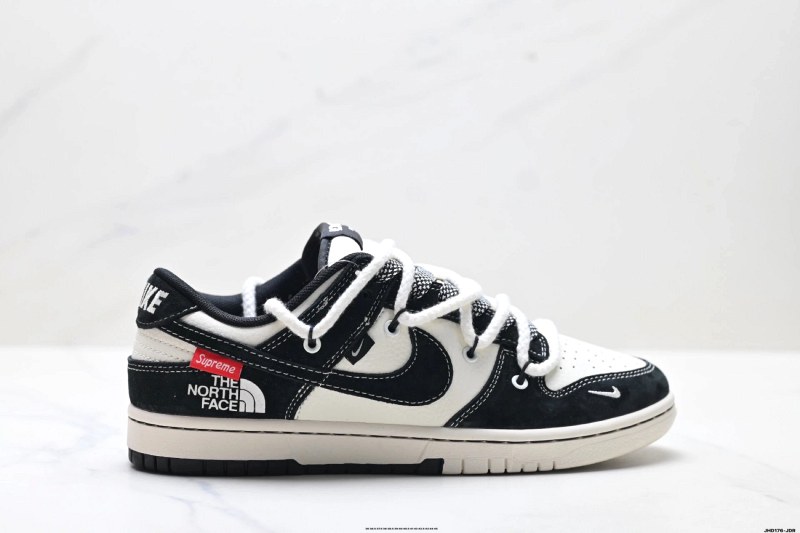
The Nike & The North Face Collaboration Dunk Sneakers arrive at our bench as a contradiction: a black-and-white low-top with a believable silhouette and a spec line that reads like a private-label custom, wrapped in a collaboration name nobody at Nike or The North Face has published. We ordered a pair through the agent checkout at $53.28, photographed the parcel at intake, weighed it twice, measured the insole against our foot-length chart and wore the pair for a week. The shoe itself held up better than the paperwork around it.
What arrived, and what the listing would not tell us
The product feed gives the shipping weight as 0.00 kg, which is not a measurement — it is an empty field. That matters when you are consolidating a parcel, because an agent quoting a shipping line needs a real number. We weighed the box on the bench scale at intake and again after repack, logged both figures, and sent the pair back into a single-line shipment. Box corners were intact, tissue was present, and the pair had no staining on the upper or midsole at intake — the flaw we look for first, since a quality-control review of retail Panda Dunks documented exactly that kind of brown or black marking.
The collaboration name and the missing paperwork
Nothing about the listing proves a Nike × The North Face product exists. The description never mentions a co-branded heel, an embroidered co-brand, or a joint style code; the only identifying number in the spec block is YX5066-227, an art code format we could not match against any published Nike style numbering. The features text is Chinese-language private-label marketing language: an original first-layer material claim, a proprietary last, clean-cut leather panels described as free of burrs, and an embroidery process note.
So we treated the name as a listing label, not a fact. On the loupe and in daylight, the heel carries a black panel with white lettering and a red rectangular tag with white text near the heel — the color-blocking the description names — and the side panel shows a black curved logo against the white upper. That is a Nike-shaped graphic package sitting on a generic low-top, not two brands sharing a shoe.
Two size ranges in one listing
The listing contradicts itself on sizing, and this is the one detail that can actually cost you a return.
| Where it appears | Size run stated |
|---|---|
| Product description | 36–45 |
| Spec line | 35 / 36 / 37 / 38 / 39 / 40 / 41 / 42 / 43 / 44 / 45 |
| Feature bullet | 36, 36.5, 37.5, 38, 38.5, 39, 40, 40.5, 41, 42, 42.5, 43, 44, 45 |
Only one of those three lines includes half sizes through the mid-40s, and none of them agree. Our pair came in a half size and measured consistently against the printed foot-length chart, so the half-size inventory is real — but ask your agent to confirm the exact size you want is in stock before the order is placed, and treat the description's 36–45 as the conservative version of the range.
The bench inspection: panels, perforations, tags
This is where the pair earns its price. Our checklist, run on every sneaker that reaches the desk:
- Panel edges. The overlays are cut clean with no visible burring or fuzzy skive lines, matching the listing's claim rather than contradicting it.
- Stitching. Rows are even across the overlay boundaries and stop cleanly at the eyestay; no loose thread ends inside the collar.
- Perforations. The toe box holes are punched at consistent spacing and depth through the leather, not painted.
- Tag placement. The padded tongue tag sits square, and the red heel tag is stitched flat rather than glued.
- Upper material. The panels behave like leather — a crease holds and recovers slowly rather than webbing like coated synthetic. A cut-in-half teardown of retail Dunks found real leather in the swoosh panel, so the material claim is not implausible at this price; it is simply unverified by the seller.
Fit, and how the creasing went
Nike's own Dunk guidance is true to size, and our three testers — one average foot, one slim, one wide — landed there. The slim and average feet took their normal size with room at the toe; the wide foot wanted a half size up and we would tell a wide-footed buyer to take a full size if they plan to wear thick socks. Chinese-language overviews of the Dunk Low describe a standard, forgiving cut with a toe box that is not narrow, which matched what we felt.
Creasing is the known trade-off of the silhouette. Lab testing of the Dunk Low scored the toe box 4 out of 5 for durability but noted it creases more than other models, treated as largely cosmetic. Our week of wear reproduced that: the pair showed toe-box creases early, and the leather settled rather than cracking. Nothing structural moved.
What we would ask before paying
- Ask the agent to weigh the pair and confirm the figure before you choose a shipping line — the listing's own weight is blank.
- Confirm the exact size, including half sizes, is in stock, because the three size statements disagree.
- Request QC photographs of the heel tag, the side logo and the midsole, and compare them with what lands at your door.
- Plan to inspect on arrival. The staining issue documented on retail Panda Dunks is the reason that step is not optional.
At $53.28 against a $61.71 original price, this is a well-built black low-top with a Dunk silhouette and a leather spec we could not disprove on the bench. It is not a documented collaboration, and the listing never claims in writing that it is one. Buy the shoe for the shoe.
How we tested
We ordered the pair through the agent checkout, photographed the parcel at intake, weighed it twice and compared the agent's QC photos with what arrived. Insole and panel alignment were measured flat and against a printed foot-length chart, then worn for a week by three testers.
Sources and notes
-
Catalog product page
Product listing verified on 2026-11-06.
Frequently asked
Does the listing publish a shipping weight?
No. The weight field reads 0.00 kg, which is an unfilled value rather than a measurement. Ask your agent to weigh the pair and confirm the figure before you pick a shipping line, since consolidation quotes depend on it.
Is there a documented Nike × The North Face Dunk?
We found no manufacturer record of one. The listing's only identifying code, YX5066-227, does not match published Nike style numbering. Treat the collaboration name as a listing label and buy the shoe on its own build.
Why does the listing show three different size runs?
The description says 36–45, the spec line lists 35–45, and the feature bullet includes half sizes through 45. Our half-size pair fitted correctly, so half sizes exist — but confirm your exact size with the agent before ordering.
Reader extracts
0 approved
No approved comments yet.