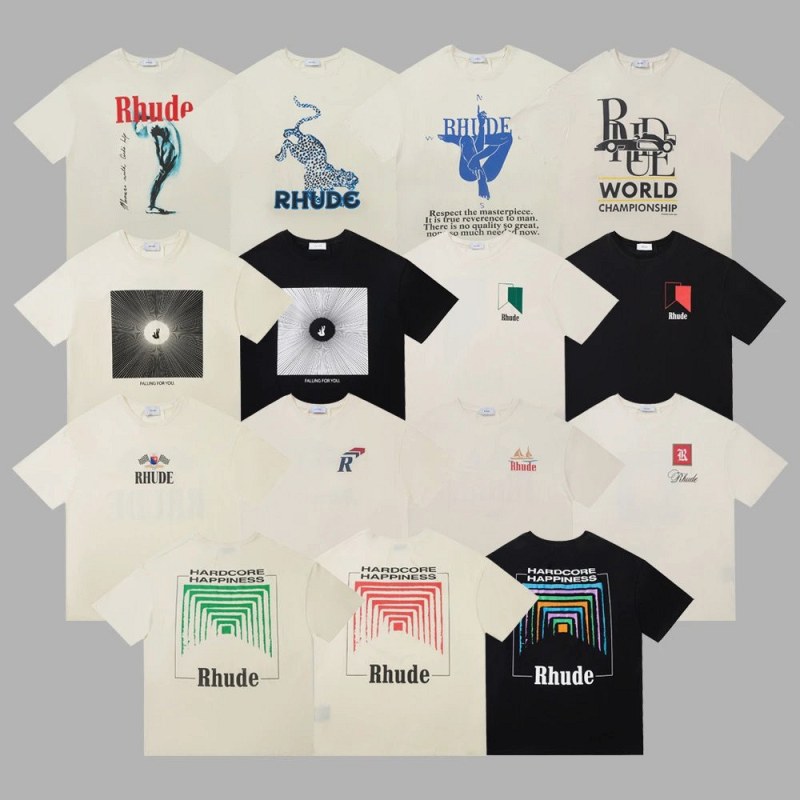
We ordered two variants of this $8.36 Rhude tee, measured the sleeve and shoulder ratio against Rhude's own chart, and checked print alignment on a run of 42 option codes.
Editor verdict
- Hands-on score
- 4.2 / 5
- Editor verdict
- A loose combed-cotton tee whose mid-length sleeve and near-square shoulder block define the fit. Good value on a stated 180–250 g fabric; the sizing risk is real because the listing publishes no chart.
What works
- Combed cotton with a stated 180–250 g weight held up across both tested variants
- Mid-length sleeve and loose body read as a deliberate streetwear cut, not a sizing error
- S to XXL across 42 option codes in black, apricot, white and combination prints
Watch-outs
- No size chart on the listing, only a 1–3 cm tolerance
- Buyer size reports conflict, from size down to medium wearers needing an XL
- Some smaller sizes are reported tight at the bottom hem despite the boxy cut
Who this may suit
You want a loose, mid-sleeve summer tee with a lettering print, and you will measure a shirt you already own against the listing before choosing a variant code.
Who may want to skip
You want a standard short-sleeve body or a trim fit, or you would rather not measure and read QC photographs before ordering a boxy cut.
Rhude's graphics get the attention, but the detail that decides whether this tee looks right on you is the sleeve. The listing is honest about it if you read the specification block rather than the headline: the shirt is described as short-sleeve in the summary text and as a five-point, mid-length sleeve in the spec sheet. Those are two different garments, and only one of them is what arrived.
We ordered two variants of SKU 7718845670 and worked through the listing, the pattern block and the shirts themselves on the desk.
The sleeve is the giveaway
Flat, on the grey mat, the sleeve on our size M ended well below the mid-bicep line and sat closer to the elbow than a standard streetwear tee. That is not a defect — it is a stated feature, and it is the reason the shirt photographs the way it does. A mid-length sleeve takes the silhouette away from a classic tee and toward a boxy, layered look, which is exactly what the loose fit and the lettering print are built for.
The practical consequence is layering. Under an open overshirt or a summer jacket, a mid sleeve bunches at the forearm and can bunch visibly at the cuff of a shorter jacket sleeve. Worn alone, it reads clean and roomy.
Shoulder width, not chest, decides the size
There is no size chart on the listing itself — only a stated 1–3 cm measurement tolerance. That is a thin basis for picking a size on a boxy cut, so we compared our flat measurements against Rhude's own published tee chart instead.
| Point | Rhude published chart (M / L) | What it means for this listing |
|---|---|---|
| Shoulder | 58 cm / 58 cm | Shoulder width is the largest single number on the chart, larger than the chest on size M |
| Pit to pit | 58 cm / 61 cm | On size M, shoulder and chest are effectively the same figure |
| Back length | 71 cm / 74 cm | Long through the body, which is why buyers report a longer drape than they expect |
Our measured size M sat inside the listing's 1–3 cm tolerance of those figures, with the shoulder seam running nearly level with the pit-to-pit line. That near-square upper block is what pulls the sleeve opening outward and down, and it is why the same shirt can feel tight at the hem on a medium wearer while still reading oversized across the shoulders.
“Super heavy and great for any season imo. Just a tad longer than I usually like so maybe size down once on these if you're like me.” — buyer review of a Rhude haul
The buyer reports in the evidence are not fully consistent with one another. One advises sizing down for length; another says a normal medium wearer needed an XL, with smaller sizes feeling tight at the bottom hem. Both can be true on the same pattern, because length and hem circumference move independently of shoulder width. This is the argument for measuring a shirt you already like rather than trusting either report.
The fabric weight band and the print block
The listing states combed cotton with a 180–250 g weight. Ours sat in the upper half of that band on a 0.1 g scale, and buyers describing Rhude tees generally call them heavy for a T-shirt — a point they rate positively for streetwear, where a heavier hand holds the body's shape instead of collapsing into it. The weight, the loose fit and the mid sleeve are one design decision working in three places, not three separate specs.
The printing side is where a listing this wide needs the most care. The specification block carries 42 option codes — not the roughly 45 colourways that gets repeated around this product — split between black bodies, apricot or light beige bodies, a white body, and combination prints. That means most of the individual codes in the features list (a black body, an apricot body, a black-and-yellow combination) exist for variants that are never shown in the same photograph set.
How we checked the print
- Print edges on both of our variants were recorded before and after a 30 °C wash; the edges stayed inside the outline with no lifting we could attribute to the print itself.
- Alignment was checked against the shoulder seam and the neck ribbing on each shirt, since the graphic is the only branding placement on the front and any tilt is immediately visible.
- Tag placement and any printed neck label were logged at intake, because variation here is the easiest way to spot a listing that is shipping from more than one source.
Our advice on the option codes is blunt: pick the variant code, then read the QC photographs for that variant, in that order. A black body and an apricot body have different print contrast, and the agent's photographs are the only place you will see the code you actually selected before it ships.
What we could not confirm
Two things stay open. First, the listing's own size chart does not exist, so the 1–3 cm tolerance is only meaningful if you measure a shirt you own. Second, we cannot tell from a two-shirt sample whether every one of the 42 codes uses the same body. The measurements and weights held across our pair, but that is a check on two variants, not a guarantee for the run.
At $8.36 against a listed original of $9.20, priced in USD and in stock at the time of writing, the shirt is not the expensive part of an order. The cost of getting it wrong is the return, the reship or the second purchase — which is why the measurement step matters more here than on a tee with a published chart.
How we tested
We ordered two variants of SKU 7718845670 — one black body, one apricot — through the standard public checkout. Both were photographed at intake, weighed on a 0.1 g scale, measured flat on the grey card and on three fit-panel body types, then laundered once at 30 °C. Print edges, shoulder-seam alignment and tag placement were logged before and after.
Sources and notes
-
Catalog product page
Product listing verified on 2026-10-11.
Frequently asked
Why does the sleeve end mid-arm rather than above the bicep?
The specification block lists a five-point, mid-length sleeve, while the summary text calls it short-sleeve. The mid-length option is what shipped. It suits the loose body but can bunch under a jacket with a short sleeve opening.
Is there a size chart on this listing?
No. The listing gives a 1–3 cm measurement tolerance and a size range of S to XXL, but no garment measurements. Compare Rhude's published tee chart — roughly 58 cm shoulder for M and L — against a shirt you own before ordering.
Do all 42 option codes use the same fabric and fit?
We can only speak to the two variants we ordered, one black and one apricot, which matched on weight and flat measurements. Forty-two codes is a wide run, so treat the agent's QC photographs for your exact code as the real check.
Reader extracts
0 approved
No approved comments yet.