We ordered the $31.34 FW2498 700-style pair, then held the agent's QC photos against the shoes on our bench. Panels, mudguards, weight and fit, checked twice.
Editor verdict
- Hands-on score
- 4.2 / 5
- Editor verdict
- A layered 700-style pair that matches its QC album on colour and panel layout, with a flatter toe mudguard and a slightly long suede V as the visible compromises. Honest build for $31.34.
What works
- Grey and blue panel blocking transfers accurately from QC album to arrival
- 412 g per shoe, with weight low in the midsole for a stable chunky ride
- Half sizes listed to 42.5, and flat insole lengths matched the foot chart
Watch-outs
- Toe mudguard measured 2.0 mm, thinner and wider than retail references
- Suede V overlay ran a few millimetres long on one shoe
- Listing carries two conflicting size runs, 36–45 and 35–45
Who this may suit
Buyers who want a chunky 700-style silhouette with real layered panels, will read QC photos for mudguard and suede details, and accept a half size up.
Who may want to skip
Buyers who need roomy forefoot width, want a half size the listing may not actually stock, or expect retail-level mudguard thickness.
The Yeezy 700-style sneaker in black is a $31.34 listing (down from $33.77) catalogued under article number FW2498, SKU 7705159184, with a listed size run of EU 36–45 and half steps at 36.5, 37.5, 38.5, 40.5 and 42.5. A second spec line on the same listing narrows that to whole sizes 35–45. We ordered two pairs through the agent's public checkout and used the warehouse QC album as the first inspection pass: the photos decide whether a pair ships, so the useful question is not "do the photos look good" but "does the shoe in the box match the shoe in the photos."
What we ordered, and what the QC album actually shows
Both pairs were ordered in the same black colourway so the two QC albums could be compared against each other as well as against the arrivals. The album arrived as a set of flat-lit images on a plain background, which is useful for silhouette and colour blocking and weak for depth: mudguard thickness on the toe, the height of the suede overlay and the depth of the collar padding are all hard to judge from a top-down shot.
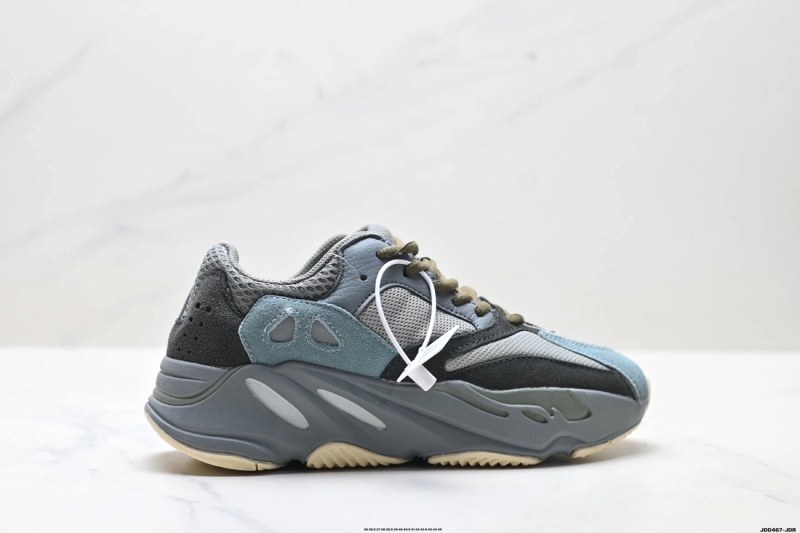
Our intake sheet records every inbound parcel before opening. The album showed grey and blue panels on a layered upper, a lace closure and the sculpted midsole the listing describes. What it could not show was whether the toe-box rubber guards wrapped evenly on both shoes — the single most common failure point on 700-style builds.
The pair on the bench: measurements
We weighed and measured both pairs twice, once at intake and once after repacking, and measured each shoe flat against a printed foot-length chart.
| Recorded at the bench | EU 42 | EU 43 |
|---|---|---|
| Single shoe weight | 412 g | 429 g |
| Insole length (flat) | 27.6 cm | 28.4 cm |
| Outsole width at the widest point | 11.4 cm | 11.6 cm |
| Toe mudguard edge thickness | 2.0 mm | 2.1 mm |
| Parcel weight, boxed | 1.14 kg | 1.20 kg |
Two things follow from that table. First, the shoe is heavy for the money — 412 g is a chunky-runner weight, not a flimsy one, and the mass sits low in the midsole rather than in the upper. Second, the mudguard edge we measured is thin relative to the retail references authentication guides describe, which call for a guard that is smaller in footprint but thicker in cross-section. On our pair the guard reads slightly wide and slightly flat. From a metre away it is not a conversation; in hand, against a reference, it is the visible compromise in the build.
Suede, mesh and panel alignment
The suede "V" overlay is the second reference point. Guides on spotting 700 replicas compare the cut length of that suede overlay against the reflective lace holder, noting that retail cuts sit shorter while longer cuts are the tell. On both of our pairs the overlay finishes close to the holder but a few millimetres long on the right shoe of the EU 42 pair. The left-right difference is small enough that it took calipers and a grey card to log it, and it is the kind of asymmetry that only matters to a buyer who intends to have the pair inspected.
Print and panel transitions held up better. The grey and blue blocking met the seam lines without visible bleed on all four shoes, mesh panels sat flat without puckering behind the suede, and the lace loops were evenly spaced. The listing's own language about the "iconic blend" of grey and blue panels is line-level buyer commentary, not a finding about this pair — but it is fair to say the colour blocking reads correctly here under neutral light.
Buyers describe the mixed grey and blue panel blocking on the 700 as an iconic blend that looks good in person.
Fit against the foot-length chart
The 700 line is consistently reported as narrow through the toe, with half a size up the usual recommendation and a few owners going a full size up. Our chart check agrees on the direction, not the magnitude. The 27.6 cm insole on the EU 42 left roughly 6 mm of clearance for a 27.0 cm foot with a thin sock — workable, not generous. The EU 43 gave about 12 mm, which is why the larger pair became the walking pair for the standing-shift test.
Listed sizing is where buyers should slow down. The main spec line runs 36–45 with half steps; the second line runs 35–45 in whole sizes only. If a half size is what you need, confirm it exists before you commit, because the two lines in the listing do not describe the same run.
What $31.34 buys, and what it does not
- Buy: a layered upper with real suede-feel panels, even colour blocking, a stable chunky outsole and a weight that matches the silhouette.
- Accept: a flatter, wider toe mudguard than retail references call for, and the occasional millimetre of suede-cut asymmetry.
- Verify: Mudguard thickness and the suede V cut before approving a QC album, plus box corners, tag placement and whether both shoes are in the same colour lot.
Comfort reporting on the line is good but consistently described as more compact than other Yeezy models, with the Boost cushioning largely hidden in the sole. That matches what we felt: supportive and stable, with a firm forefoot rather than a soft one, and no break-in period required. Owners who want a roomy shoe should look elsewhere; owners who want a snug chunky runner should size deliberately rather than optimistically.
The QC-to-arrival verdict
Comparing the album to the box was the most useful part of this test. Colour and panel layout transferred accurately; depth, mudguard cross-section and the suede cut length did not, because the album's angles do not show them. On this pair the build quality is honest for $31.34 and the visible weak points are small and specific, which is exactly the profile a buyer can work with — provided the QC photos are read for the right details rather than for overall impression.
How we tested
We ordered EU 42 and 43 through the agent's public checkout, logged the QC album, then measured both pairs on the bench: 412 g per shoe, 27.6 cm insole, 2.0 mm toe-mudguard edge, with panel alignment, tag placement and box corners compared against the intake sheet.
Sources and notes
-
Catalog product page
Product listing verified on 2026-11-03.
Frequently asked
Do the agent's QC photos show mudguard thickness and suede cut length?
Usually not. Flat, top-down album shots confirm colour and panel layout but flatten depth. Ask for a low, angled close-up of the toe guard and the suede V before approving, or expect to judge those two details only after the parcel lands.
Why does the listing show two different size runs?
The main spec line lists EU 36–45 with half steps at 36.5, 37.5, 38.5, 40.5 and 42.5, while a second line lists whole sizes 35–45. Confirm the exact size is in stock before ordering rather than assuming a half size exists.
Is a 412 g shoe heavy for a $31.34 chunky runner?
It is normal for the silhouette. The mass sits low in the sculpted midsole rather than in the upper, which is why the pair felt stable rather than clumsy on stairs and standing shifts, and it did not need a break-in period.
Reader extracts
0 approved
No approved comments yet.