## What purchase problem this QC check solves Before buying a [Loro Piana](https://fashion-reps.net/brand/loro-piana) scarf, what you really need to confirm isn't whether the photos look "nice," but whether the page records and QC photos together support your order decision: whether the dimensions suit your intended use, whether the color and pattern match the product description, whether there are visible issues with edges and stitching, whether tags and packaging photos help verify what's bein
What purchase problem this QC check solves
Before buying a Loro Piana scarf, what you really need to confirm isn't whether the photos look "nice," but whether the page records and QC photos together support your order decision: whether the dimensions suit your intended use, whether the color and pattern match the product description, whether there are visible issues with edges and stitching, whether tags and packaging photos help verify what's being shipped, and whether you're still within a return/exchange window if any issues are found. 🧣
This article only covers the photo verification method for one specific scarf product; it doesn't extend photo observations to conclusions about authenticity, material grade, or final quality assurance. Editorial judgments must be recorded separately from evidence directly visible in the photos.
Enter the verified product detail page and open View QC Photos
Start from the product detail page on fashion-reps for this specific item; don't infer the scarf's condition from the homepage, brand pages, category pages, or photos of other products. Confirm the product name, color, size or specifications shown on the page, and check the page's last update time. Price, stock, seller, shipping, and return/exchange terms should all be re-checked before ordering, as these can change.
After entering the product detail page, click the button labeled View QC Photos. The QC gallery should clearly correspond to the current product, not recommended products, other styles from the same brand, or generic display images. It's recommended to view and save records in the following order:
- Full view: Confirm the item in the photos matches the product name, color, and style.
- Flat lay or measurement photos: Look for rulers, measuring tools, or clear size references.
- Pattern and edge photos: Check repeating patterns, corners, hems, and any fraying.
- Tags and packaging photos: Verify that tags, hang tags, packaging, and product description correspond.
- Detail photos: Check for obvious stains, snags, damage, loose threads, creases, or color differences.
If the button won't open, photos are from another product, the number of photos is insufficient to cover key areas, or the gallery can't prove correspondence, record the verification status as insufficient information rather than concluding that unclear areas are problem-free. ⚠️
How to compare scarf dimensions and fit with page records
The length, width, fringe length, and edge shape of the scarf directly affect how you can drape, wrap, or wear it. Just because the product title says "long" or "large" or the photos show proportions doesn't confirm actual dimensions. Prioritize finding flat lay photos with a ruler, or ask your shopping agent for flat lay measurement photos of the current batch.
When comparing, record three sets of information:
- Page specifications: Length, width, color, and style description stated on the product detail page.
- Photo readings: Ruler start point, end point, measurement direction, and whether fringe is included.
- Acceptable differences: Whether the seller or agent has stated manual measurement errors, shrinkage risks, or measurement methods.
If the page states the main body length excluding fringe, but the photo measurement includes fringe, the two cannot be directly compared. Without clear measurement references, you can only confirm that "the photo shows the product," not specific dimensions. 📏
For fit, also observe whether the scarf can be fully unfolded, and whether edges and corners are hidden due to folding, curling, or obstruction. Drape in the photos may be affected by placement, lighting, and shooting angle, and cannot guarantee actual thickness, softness, or warmth.
How to organize visible evidence of pattern, edges, and stitching
Pattern verification should go from overall to detail. Overall photos confirm main color, pattern direction, and distribution; detail photos check whether repeating patterns have obvious misalignment, breaks, uneven dyeing, or abrupt pattern interruption at edges. Slight reflections, creases, and shadows should not be taken as color differences or stains.
Edges and stitching can be recorded by location:
- Long edges: Check if the hem is continuous, or if there are obvious waves, loose threads, or variations in width.
- Short edges: Check if corners are aligned, or if there is fraying, notches, or gathered stitching.
- Fringe area: Confirm if lengths are roughly consistent, or if there are obvious knots, missing strands, or messiness.
- Pattern seams: Look for visible abrupt misalignment near edges.
"Looks neat" is an editorial judgment; "there's a loose thread sticking out on the lower left long edge" is verifiable visible evidence. When recording, write the location, photo number, and observation clearly, and avoid words like "top quality," "perfect," "flawless" that cannot be proven by photos.
What tags, packaging, and detail photos can and cannot tell you
Tags, hang tags, and packaging photos help verify that shipped contents, color, specs, and accessories match the page record. If tag information is blurry, covered, or inconsistent with the product page, ask the agent to take additional photos rather than filling in the text yourself.
These photos can support judgments including:
- Whether the tags or packaging parts described on the page appear in the photos.
- Whether visible text on tags clearly conflicts with the product name or specs.
- Whether there are obvious missing accessories, damaged packaging, or wrong item signs.
These photos alone cannot prove:
- That the product is authentic or fake.
- That fabric composition, hand feel, weight, or warmth meets a certain standard.
- That the product has undergone complete professional quality inspection.
- That subsequent shipping won't cause creases, contamination, or damage.
Brand logos in the photos are only appearance records, not authenticity conclusions. If your purchase purpose involves brand authorization, authenticity disputes, or high-value risk, confirm the agent's dispute handling, return/exchange terms, and acceptable evidence scope before ordering. 🔎
How to separate visible flaws from editorial judgments
A two-column record is recommended, but you don't need to make a table for every part. Each record should at least include location, visible fact, judgment strength, and next step.
Visible fact examples:
- "There is a small loose thread near the corner on the right long edge, visible in the photo."
- "The flat lay photo has no ruler, so length cannot be confirmed from the photo."
- "The pattern is covered by a fold, so the left half cannot be fully compared."
- "The packaging photo does not show the tag, so cannot confirm it will be included."
Editorial judgment examples:
- "Whether this loose thread will continue to unravel cannot be determined from the photo."
- "Current evidence is insufficient to confirm the size is suitable for the intended wrap style."
- "The pattern difference might be due to lighting, but additional photos are needed to rule out obvious color difference."
When a flaw may affect use, appearance, or return disputes, save the original photos, product page records, and agent replies together. Don't crop out key areas or use editing to hide damage. If screenshots contain names, addresses, order numbers, payment info, or full shipping labels, these personal details must be obscured before publishing or sharing. 🛡️
Stop conditions when information is missing or photos are insufficient
If any of the following occurs, do not directly mark the product as "QC passed":
- Cannot enter the corresponding View QC Photos gallery from the product detail page.
- Photos cannot prove they correspond to this specific scarf.
- Not enough photos to check long edges, short edges, corners, fringe, and tags.
- Page specs conflict with visible colors, styles, or accessories in photos without explanation.
- No clear measurement reference and target use requires specific dimensions.
- Photos show suspected stains, damage, loose threads, or obvious wrong item, but agent has not explained resolution.
- Return/exchange window, handling fees, or evidence requirements not confirmed.
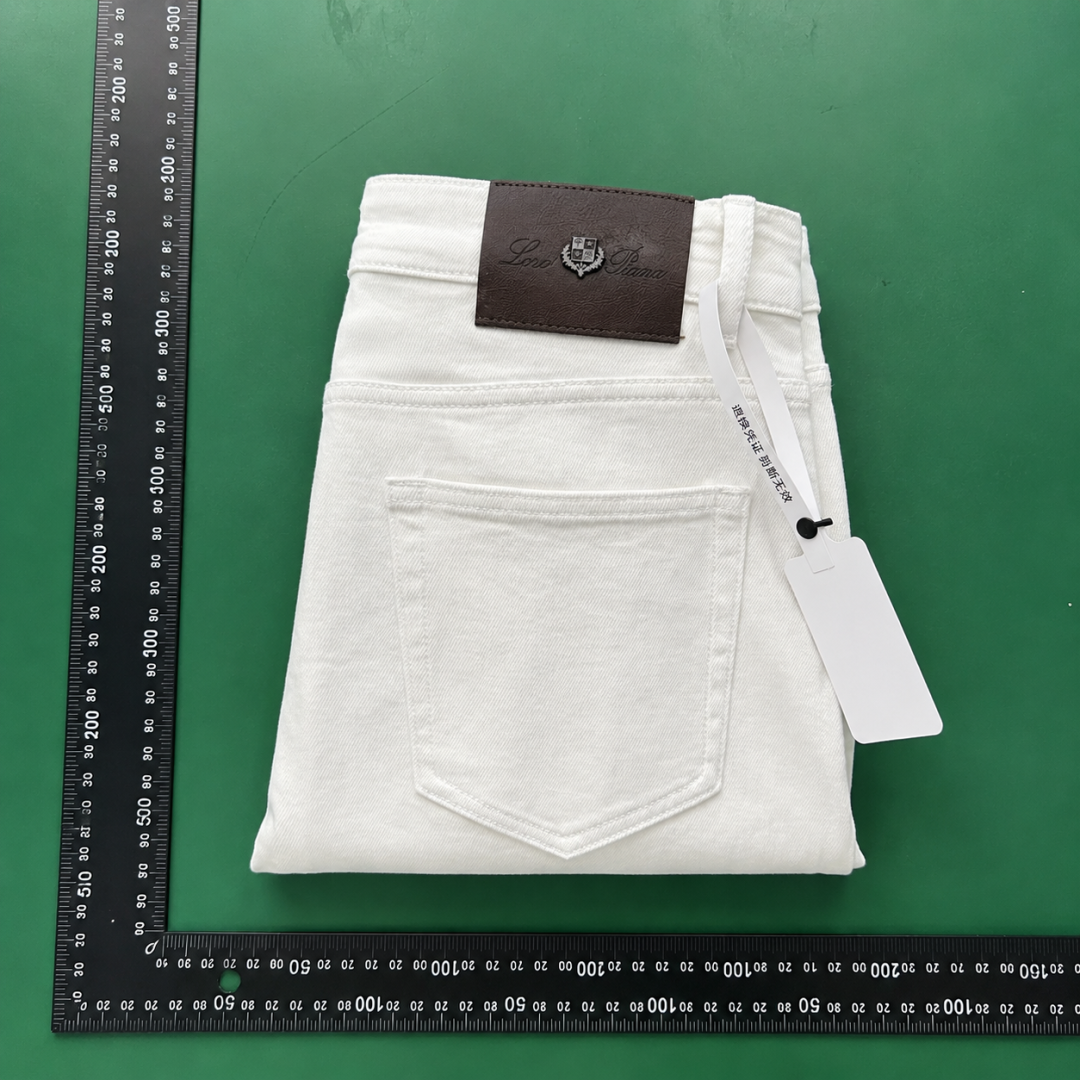
The currently available specified photo evidence does not match this scarf; it shows another Loro Piana white jeans item, so it cannot be used as the scarf's QC original photo, nor can it be used to judge the scarf's dimensions, color, stitching, or flaws. You should return to the corresponding product detail page, click View QC Photos, and obtain real and traceable scarf photos before continuing. ⛔
Action checklist before ordering or requesting further verification
Before ordering:
- Confirm product detail page name, color, specs match the target item.
- Open the corresponding gallery via View QC Photos and verify photos are not of another product.
- Obtain clear flat lay measurement photos, clarifying whether fringe is included and measurement error.
- Check long edges, short edges, corners, fringe, pattern, and tag areas.
- Record visible facts separately from editorial judgments.
- Confirm suspected flaws, additional photo scope, return/exchange window, and related fees with the agent.
- According to destination country, route, and package value, confirm shipping, taxes, import restrictions, and declaration requirements; do not use under-declaration, splitting orders to avoid tax, or evading inspection.
If after additional photos the size, color, and structure evidence are clear, and visible flaws are within your acceptable range, then decide whether to order. If photos are still insufficient to support judgment, the safest action is to pause the purchase rather than substitute brand impression, blurred photos, or other product photos as evidence.
Article featured image

Reader extracts
0 approved
No approved comments yet.