If you're looking at this Polo Ralph Lauren navy stand-collar down vest, the biggest mistake to avoid is directly applying another vest's "runs big" or "runs small" feedback. This model has no independent buyer size feedback on its page, and the page information alone doesn't prove it has the same fit as other Polo Ralph Lauren vests. So sizing should start from
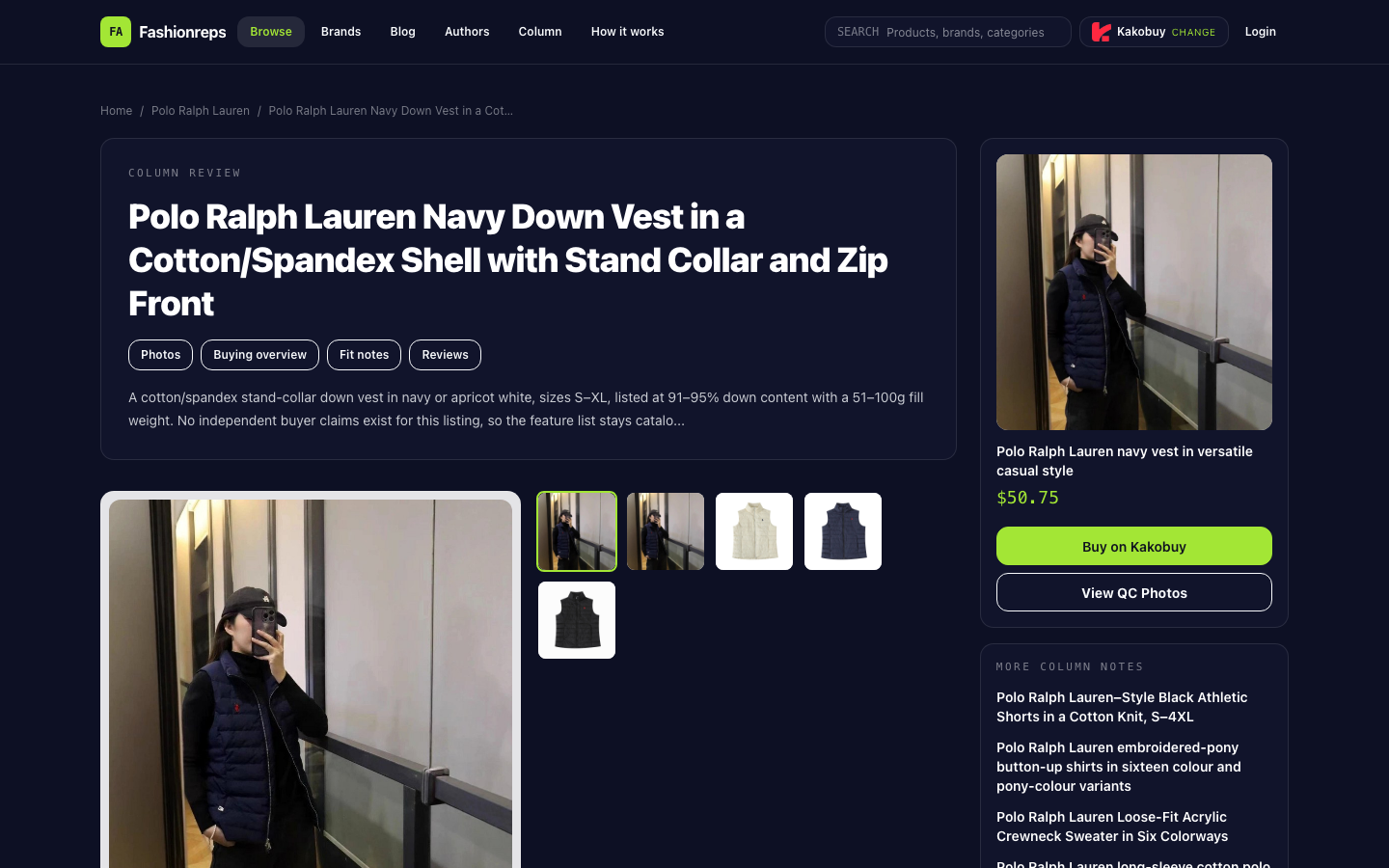

If you're looking at this Polo Ralph Lauren navy stand-collar down vest, the biggest mistake to avoid is directly applying another vest's "runs big" or "runs small" feedback. This model has no independent buyer size feedback on its page, and the page information alone doesn't prove it has the same fit as other Polo Ralph Lauren vests. So sizing should start from your own body measurements, the item's size chart, and your layering needs.
What the Product Page Clearly States
This model is offered in sizes S through XL, with navy as one of the listed colors. The fit is described as tailored, and the length range is 50 to 65 cm. The page also lists a cotton-blend stretch outer shell, stand collar, zippered front, and non-removable design. Fill information states white duck down, with down cluster content of 81% to 85%, down content range of 91% to 95%, and fill weight of 51 to 100 grams.
These details help determine the intended use, but they can't replace specific size measurements. In particular, 51 to 100 grams is just a range; it doesn't allow precise judgment of warmth for a specific size, nor does it prove suitability for extreme cold. A more reasonable understanding is: it's closer to a lightweight layering vest, meant to be worn over hoodies, knits, or light jackets, rather than as a heavy outer layer for deep winter.
Why You Can't Copy Feedback from Other Vests
There's no consistent size trend across different vests from the same brand. The source page mentions that another Big & Tall quilted vest had feedback leaning toward running large, while another reversible down vest had feedback of running small and tight. This only shows that different styles can vary; it doesn't tell you how this particular S, M, L, or XL will actually fit.
This model is also labeled tailored. If you plan to wear only a thin T-shirt or shirt underneath, tailored fit may match expectations. But if you need to add thick hoodies or chunky knits for fall/winter, you can't just order your usual brand size; you need to compare chest, shoulder mobility, and length.
Choose Your Size Based on Your Own Measurements
First, gather three sets of data: your body chest circumference, the chest circumference of your usual inner layer, and the chest width and length of a vest or jacket that fits you well. When measuring, lay the garment flat and don't stretch the zipper or fabric.
Recommended sequence:
- Find the size chart for this specific model on the product page. Record chest or width, length, and shoulder width if provided.
- Compare your body measurements to the chart; don't substitute with another Polo Ralph Lauren vest's chart.
- Measure a vest that fits you for fall/winter, focusing on underarm chest width and length.
- If you plan to layer over hoodies or thick knits, prioritize checking chest and underarm room, not just length.
- If two sizes are close, decide whether you prefer a trim fit or extra room, then ask the seller for flat measurements if needed.
Flat chest width can be used for comparison, but you can't simply multiply by two to get the actual wearable chest circumference. Fill, stand collar, zipper closure, and cut all affect wearing space, so it's only a secondary reference.
Navy Color and Fall/Winter Layering
Navy is generally easy to pair with gray, beige, white, black, and denim, but color doesn't change sizing. What really matters is what you'll wear underneath.
If you'll mainly wear shirts, thin long sleeves, or lightweight knits, a tailored size usually keeps shoulders and hem neat. If you'll mainly wear thick hoodies, fleece, or loose knits, measure with that inner layer on, or compare with a garment of similar thickness laid flat. Don't blindly go up two sizes for a loose fit, because length, shoulder position, and collar fit may all change.
The page doesn't provide independent buyer try-on data, so we can't confirm if a size fits specific heights, weights, or body types. When body measurements vary significantly, the product page's flat measurements are more useful than brand impressions.
Final Decision Process Before Ordering
Before confirming your size, break the decision into three steps:
Step one: Check if this model still has your needed size and navy option. Existing info only shows the page listed S–XL and navy; it doesn't imply current stock or availability.
Step two: Compare the size chart with your measurements. If the page lacks enough chest, length, or flat data, ask the seller for specific measurements of this model in your size; don't fill gaps with other vests' feedback.
Step three: Confirm you accept the lightweight layering positioning. The listed 51–100 gram fill weight supports lightweight wear; it doesn't promise deep winter warmth. If you want a thick insulated outer layer, not layered wear, the existing info isn't enough to order directly.
Also, the page suggests viewing QC photos of your target color before buying. Photos help you see the navy version's appearance, quilting, and logo placement, but they can't replace measurements or prove fit.
Overall, this vest is best chosen this way: prioritize the size chart and measured flat dimensions of this specific model, then decide based on your layering thickness. Don't transfer "runs large" or "runs small" reviews from other Polo Ralph Lauren vests. If key measurements are missing or your layering thickness doesn't match the page info, it's safer to get more size details before paying.
Reader extracts
0 approved
No approved comments yet.