# Nike Hoodie Shipping: Consolidate or Split to Save? Verification date: October 8, 2026 Editorial perspective: Panda-Buy Editorial Desk. This article does not [represent](https://fashion-reps.net/brand/represent) the editor personally purchasing, receiving, or wearing the items; the content is compiled from the visible product catalog on fashion-reps and public purchase processes. Buyers should re-check real-time information before submitting shipping requests. 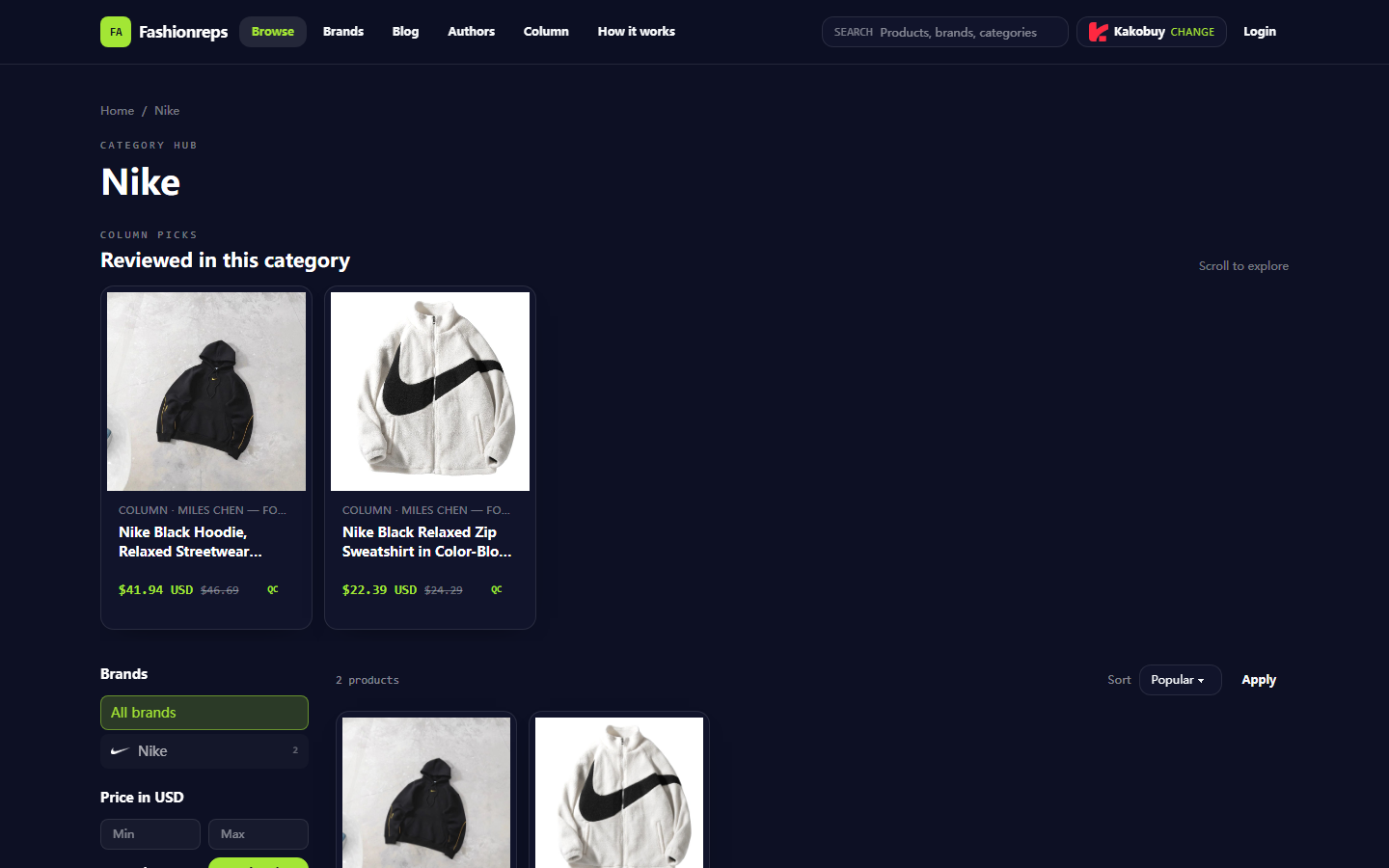
Verification date: October 8, 2026
Editorial perspective: Panda-Buy Editorial Desk. This article does not represent the editor personally purchasing, receiving, or wearing the items; the content is compiled from the visible product catalog on fashion-reps and public purchase processes. Buyers should re-check real-time information before submitting shipping requests.

Who this is for: Buyers preparing to consolidate Nike hoodie packages
If you already have two or more Nike hoodies in your shopping agent's warehouse and are deciding whether to consolidate shipping or split shipments, this article is for you. The goal is not to find a lowest price that works for all orders, but to establish a comparison method you can execute before submitting a packaging request.
After reading, you should be able to do three things:
- Record each item's actual status, packaging condition, and visible weight information.
- Compare the total cost of consolidation and split shipping under the same criteria.
- Pause submission when shipping costs, packaging restrictions, or damage risks cannot be confirmed, rather than looking only at estimated prices.
If the items have not yet arrived at the warehouse, the warehouse has no visible weight, or the agent platform has not yet provided destination country and route conditions, this article cannot replace real-time quotes. At most, you can only establish a record sheet and cannot conclude that "consolidation is always cheaper." 📦
First verify the items, packaging, and warehouse status
The Nike category page on fashion-reps currently shows two visible product records: one black loose-fit pullover hoodie, with a display reference price of $41.94, previously $46.69; and another black color-blocked fleece stand-collar zip hoodie, with a display reference price of $22.39, previously $24.29. These are reference prices from the product catalog, not final landed costs, and do not include agent service fees, packaging fees, international shipping, taxes, or exchange rate effects.
These product details can only help you identify the order composition; they cannot directly derive shipping costs. Before shipping, you should also verify item by item:
- Whether the product name, size, color, and quantity match the order.
- Whether the items have arrived at the warehouse, whether warehouse inspection is complete, or if there are visible QC images.
- Actual weight per piece, estimated dimensions, outer packaging type, and whether original packaging removal is allowed.
- Whether there are pending exchanges, refunds, additional purchases, or seller communications.
- Destination country, delivery address region, available routes, billing rules, and quote validity.
- Current service fees, packaging fees, payment processing fees, and exchange rates shown on the agent platform.
The product page shows a shopping agent selection entry, and the page states that orders, payments, and shipping are handled by the selected agent's website. Therefore, the reference price on fashion-reps cannot be treated as the final bill from the agent platform. Buyers should re-check the order and shipping pages in their actual agent account.
What visible conditions are needed for consolidation and split shipping respectively
Consolidation is generally suitable when multiple packages can be handled by the same warehouse, the destination and recipient information are the same, the route allows consolidation, and consolidation does not trigger significant dimensional weight or single-package value risks.
Split shipping may be more suitable in the following situations: an item has specific route restrictions; the package size increases significantly after consolidation; the after-sales status of different items differs; or the buyer wants to manage high-value, fragile, or urgently needed items separately from regular clothing.
Do not compare only the shipping cost of "one package" vs. "two packages." Also factor in fixed service fees, repackaging fees, dimensional weight, possible additional charges, tax applicability, and the complexity of handling loss or damage. ⚖️
| Verification item | Consolidation needs confirmation | Split shipping needs confirmation |
|---|---|---|
| Warehouse status | All items have arrived and can be processed together | Each package's item status and processing progress are clear separately |
| Billing method | How combined actual weight or dimensional weight is calculated | Whether each package triggers first weight, additional weight, or minimum charges separately |
| Packaging conditions | Whether duplicate packaging can be removed and whether volume increases | Whether each package meets route size and weight limits |
| Risk allocation | Whether single-package value, damage, and customs risks increase | Whether fixed fees and number of operations increase |
| Evidence retention | Weight, dimensions, and quotes before and after consolidation can be screenshotted or recorded | Each package's item list, quote, and tracking number retained separately |
How to record chargeable weight, volume, and packaging fees
First separate product cost and shipping cost. Product cost can be recorded as:
Product cost = reference price or actual transaction price + product discount adjustment + agent service fee + costs from payment or currency conversion
Total shipping cost should be recorded separately:
Total shipping cost = packaging fee + international shipping + route surcharges + destination country taxes or collection fees + possible additional charges
If the route uses dimensional weight, record the length, width, height, and conversion rule explicitly provided by the platform. Do not guess package volume based solely on the number of hoodies, and do not mistake the reference price on the product page for the package's declared value. If the platform only shows an estimated weight without a final weigh-in result, mark it as an estimate, not a confirmed amount.
It is recommended to create a record row for each of the two options and unify the currency. The exchange rate must note the viewing date and the conversion method used, because product prices, agent bills, and bank card charges may use different exchange rates. 🧾
When you cannot decide based solely on estimated shipping cost
The following situations are not suitable for deciding directly based on estimated shipping cost:
- The estimated weight has not been replaced by warehouse weigh-in data.
- Consolidation may switch to a different route, but the platform has not explained route restrictions.
- The fee page does not clearly state whether packaging fees, service fees, or dimensional weight are extra.
- The estimated quote does not state whether it includes taxes, fuel surcharges, or remote area fees.
- There are items in the order pending inspection, exchange, or possible refund.
- The item value or package value may trigger destination country declaration, customs, or tax requirements.
- The agent platform's quote validity, payment currency, or additional charge rules are unclear.
You cannot under-declare value, split orders to evade taxes, or circumvent inspections to lower book shipping costs. Declarations must be truthful, and destination country taxes, import restrictions, and required documents should be based on applicable regulations and carrier requirements. If in doubt, confirm with the actual agent platform or carrier first.
Shipping restrictions, damage risks, and evidence boundaries
When multiple hoodies are consolidated, fixed packaging operations may be reduced, but the package may also become larger, heavier, or increase the risk of loss in a single shipment. Split shipping usually increases repeated first-weight charges, packaging operations, and tracking management, but can spread risk across multiple packages and may avoid certain single-package restrictions.
These judgments cannot be made solely from product images. Catalog images can help confirm product names and page display status, but cannot prove fabric feel, actual thickness, garment weight, packaging compression resistance, or post-shipping appearance. If QC images show obvious stains, damage, size errors, or missing accessories, handle after-sales first, and do not directly consolidate problematic items into pending packages.
Evidence records should at least include:
- Item list before consolidation or split shipping.
- Actual weight, dimensions, and packaging photos or page records from the warehouse.
- Fee breakdown and quote time from the agent platform.
- Route name, destination country, and applicable restrictions.
- Order number, payment records, and final tracking information after submitting the packaging request.
When displaying screenshots, cover order numbers, addresses, phone numbers, payment information, and other personal data, while retaining necessary areas that allow judgment of weight, cost, or status.
Pre-shipment consolidation decision table and review checklist
When both options meet route conditions, you can compare using the table below. The "difference" in the table must come from actual quotes under the same time, same currency, and same destination conditions, and cannot be pre-filled with speculative amounts.
| Comparison item | Consolidation option | Split shipping option |
|---|---|---|
| Item and order status | Record all items to be consolidated | Record items for each package separately |
| Estimated or final chargeable weight | Fill in platform-visible data and note if estimated | Fill in separately for each package |
| Packaging and service fees | Based on actual fee breakdown | Based on per-package fee breakdown |
| International shipping and tax conditions | Check single-package limits and declaration requirements | Check each package's limits and declaration requirements |
| Visible total cost | Calculate after quotes confirmed | Calculate after quotes confirmed |
| Main risks | Concentration of single-package value, volume, and loss | Increased fixed fees, more complex management |
Before submission, confirm item by item:
- Product name, size, color, and quantity are correct.
- All inspection or after-sales issues have been handled, or are confirmed not to be shipped with the package.
- The source of weight and dimensions is clear, and estimates have not been mistakenly written as final values.
- Which items are included in the fees has been clarified, and unconfirmed items are marked.
- Declaration information is truthful, and no under-declaration or inspection avoidance schemes are used.
- Destination country, recipient details, and route restrictions have been reviewed.
- Quotes, page status, and order records for consolidation or split shipping have been saved.
Final action: Confirm conditions before submitting packaging request
If the total cost of consolidation is only a small amount lower than the split option, but significantly increases volume, single-package value, or post-damage handling risk, you should not choose consolidation just for a small difference. Conversely, if the warehouse has confirmed that packaging can be compressed, the route allows consolidation, chargeable weight is clear, and consolidation indeed reduces repeated first-weight or fixed operation fees, then consolidation may have a real advantage.
Savings should be calculated based on actual quotes: confirmed total cost of split shipping minus confirmed total cost of consolidation, and the result is the verifiable difference for this order. Without two complete quotes, do not claim any fixed savings amount.
Consolidation is more suitable for: same recipient, same destination, clear item status, route allows consolidation, and the buyer can accept concentrated single-package risks. Split shipping is more suitable for: different item statuses, different route restrictions, package volume or value may increase, or the buyer prioritizes risk diversification.
Conditions under which neither option is recommended include: unexplained fee structure, weight not yet confirmed, unclear declaration requirements, unresolved after-sales issues, or platform cannot provide sufficient order and packaging records. In these cases, save evidence and confirm with the actual agent platform before submitting the packaging request. ✅
Agent platform shopping FAQs
1. Why doesn't mulebuyus.com use Google Sheets to display products?
Google Sheets is only suitable for tables with a small number of products. When the number of products increases, loading becomes very slow and the system shows noticeable lag. This is especially severe on mobile devices, with poor visual experience and very inconvenient product search. For the same set of products, the table on mulebuyus.com loads faster and provides a better visual experience.
2. Is the spreadsheet website on mulebuyus.com safe to use?
mulebuyus.com does not collect any personal information; it only serves as a product catalog for the agent platform. All transactions are completed on the agent platform.
3. How do I search for products I want to buy on mulebuyus.com?
You can search using a single keyword, or directly browse category pages; products are also organized by brand. Longer search terms usually return fewer but more precise results than shorter terms. For example, you can search for "Air Force 1 White", "sneakers", or directly "Air Force 1".
4. What should first-time users of the mulebuyus.com agent platform pay attention to?
First-time users accessing Taobao agents through the spreadsheet usually receive a new user shipping discount package. At the same time, check the step-by-step shopping guide for beginners.
Reader extracts
0 approved
No approved comments yet.