Introduction If you're filtering [anti social social club](https://fashion-reps.net/brand/anti-social-social-club) products, the real question isn't "which tool is stronger"—it's how to organize candidate products, images, specs, links, and open questions from the website catalog into a checklist you can refer back to. This guide compares the website catalog and Google Sheets across different filtering stages, using the brand catalog and product presentation visible on the [Fashionreps](https://
Introduction
If you're filtering anti social social club products, the real question isn't "which tool is stronger"—it's how to organize candidate products, images, specs, links, and open questions from the website catalog into a checklist you can refer back to.
This guide compares the website catalog and Google Sheets across different filtering stages, using the brand catalog and product presentation visible on the Fashionreps website. It's for users who have already found a few candidate products but haven't decided which one to buy. It's not a substitute for verifying product authenticity, stock, or final prices—those still need to be confirmed on product detail pages and the actual shopping agent pages. 🔎
Clarify the Device and Tasks for Filtering anti social social club Candidates
Start by breaking the task into four actions: discover candidates, view images, record differences, and revisit links.
The website catalog is better for the first two actions. You can enter the product list from the brand page, narrow down by category, price, and sorting, then open product details or view QC information. Google Sheets is better for the last two actions, using consistent column names to record each candidate's color, size, material description, reference price, page status, and next-step questions.
Before starting, define an achievable outcome: keep two or three final candidates, with each one traceable from a table row back to its product page. If you just copy a bunch of product names into a table without recording the reasons for comparison, the table becomes a bookmark folder, not a filtering tool.
Start by Verifying Visible Products from the Fashionreps Website Spreadsheet and Site Catalog
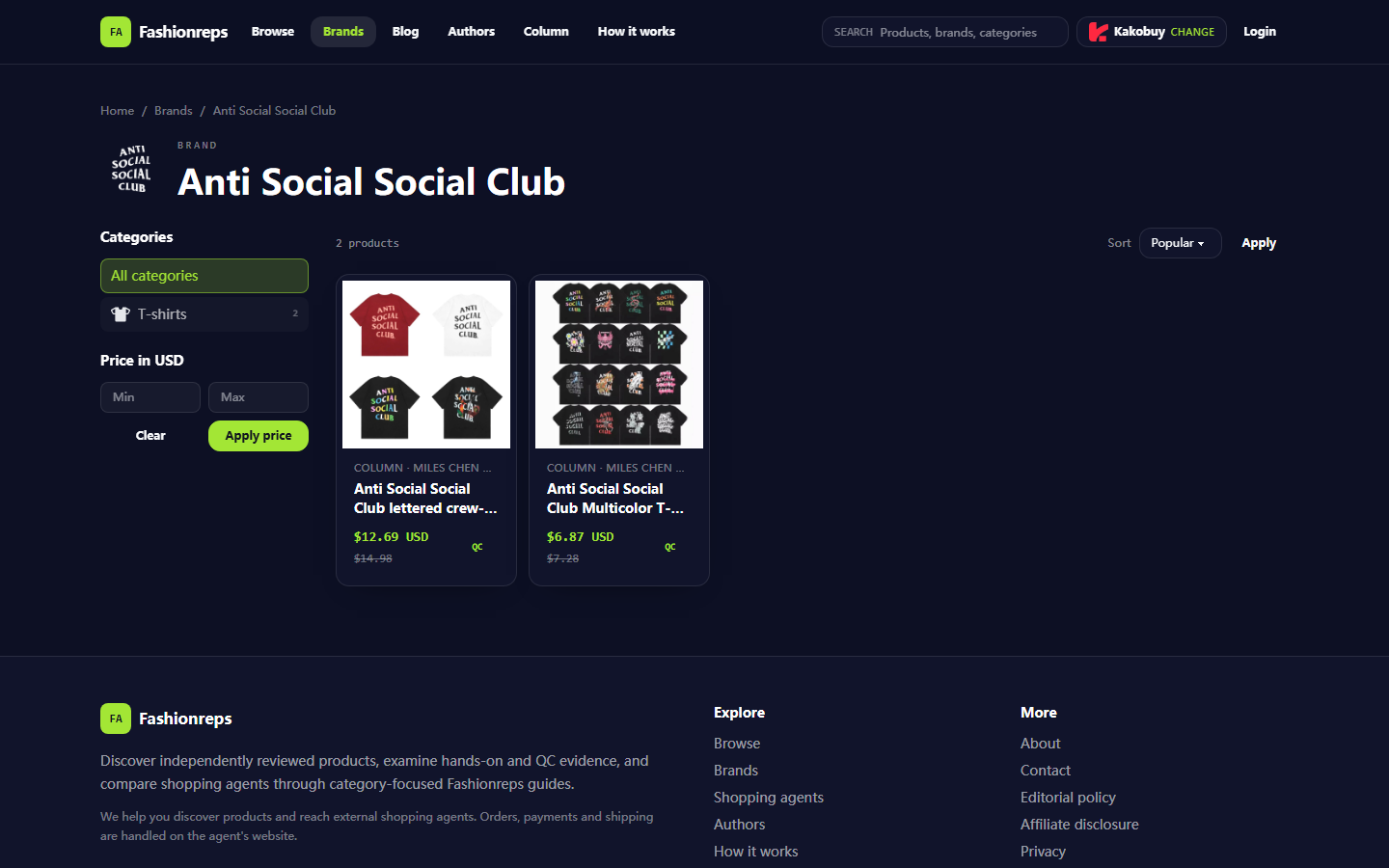
The Fashionreps brand catalog page can serve as the first entry point. The currently visible Anti Social Social Club brand page shows the T-shirts category, price filters, sorting options, and product count hints. In the page sample, you can see two candidates: one is a letter graphic crew-neck short-sleeve tee with a summary showing 230g combed cotton and 13 color options; the other is a multicolor short-sleeve collection with a summary showing relaxed raglan design and 230gsm double-yarn cotton.
This information helps you build an initial candidate list but cannot replace verification on the product detail page. Reference prices are page display information, and prices, stock, color options, and product link status can change. When recording, keep what you saw on the page separate from what still needs confirmation.
Browse in this order:
- Enter the brand catalog and confirm the product belongs to the target brand and category.
- Check the name, images, reference price, and summary specs on the product card.
- Open the product detail page and verify colors, sizes, seller info, images, and available links.
- If the page provides a QC entry, view QC images and visible notes separately.
- Write unconfirmed items into the table instead of filling them in with guesses.
The Buy button in the site catalog redirects according to the currently selected shopping agent. Product sourcing, payment, and international shipping are handled by the external agent site, so catalog page display information cannot be treated as order completion or stock confirmation. 🛒
How Google Sheets Records Specs, Colors, Product Links, and Pending Items
The value of Google Sheets is turning "what you've seen" into "why you're keeping it." Each row should correspond to one product candidate; don't mix multiple colors or links in the same cell.
Recommended fields:
| Field | Recording Method | Purpose |
|---|---|---|
| Product Name | Copy visible page name | Keep consistent with detail page |
| Product Page | Save product detail page URL | Recheck page status |
| Category | e.g., T-shirts | Avoid mixing categories |
| Color | Record only colors explicitly listed on page | Identify if further confirmation needed |
| Size | Record visible sizes or mark as pending | Support review before ordering |
| Material & Fit | Copy only explicit page descriptions | Compare fabric and cut info |
| Reference Price | Record currency and page display time | Prevent mistaking as final cost |
| Image Status | Normal, needs zoom, missing image, etc. | Determine if recheck needed |
| QC Status | Has QC, no QC, pending verification | Distinguish display vs inspection evidence |
| Pending Items | Write as specific questions | Guide next page verification |
Google Sheets filters can view subsets by category, price range, color, or status; conditional formatting is good for flagging issues like "missing size," "broken link," "awaiting QC." For collaboration, keep a status column with values like "Candidate," "Pending review," "Not keeping," "Entered agent page" to avoid duplicate checks by team members.
Don't put judgments like "looks authentic" or "great quality" that can't be directly inferred from page evidence into the conclusion column. A safer entry is "Page provides brand graphics and spec description; authenticity not verified by this site." This preserves the evidence boundary and aids later review. ✅
Compare Two Search Paths by Keyword, Category, and Image Preview
The search logic of the website catalog and Google Sheets differs.
The website catalog is good for discovering products not yet in your personal list. You can start from the brand page, category filters, price sorting, and newest or popular sorting, then use image previews to decide which products are worth opening. Its advantage is complete context: product name, images, reference price, and catalog category usually appear close together on the same page.
Google Sheets is good for processing candidates you've already collected. You can filter keywords in names, e.g., distinguish crew-neck, raglan, cotton, or different print descriptions; you can also create your own tags like "relaxed fit," "needs size chart," "many color options." However, keywords in a table are just organizing labels, not a guarantee that the site page still has the same descriptions.
Image preview is good for answering "should I open this further," not for answering "is the size right" or "is the material real" on its own. If images are blurry, colors look off, or detail shots are missing, mark as pending in the table rather than making a definitive judgment from thumbnails.
How to Recheck Links and Page Status Between Product Detail Pages and Table Rows
When setting up cross-referencing, the most important thing is one link per row and a timestamp for status changes. Pages may redirect, get delisted, change prices, or update product summaries; copying the name alone makes it hard to accurately find the original page.
Use this review flow:
- Open the product detail page from the site catalog.
- Copy the page title or product name into the table.
- Save the detail page URL, not just the brand page URL.
- Record the price, specs, and image status seen at verification time.
- Reopen the page and confirm the link still works and the product name matches.
- If the link is broken, keep the original row and change status to "Pending," don't overwrite with a new product.
If one candidate has multiple colors or sizes, split into multiple rows only if the page provides separate links for each; otherwise, keep one product row and record the options shown on the page in the color or size columns. This avoids duplicate data and prevents unconfirmed variants from being mistaken as separate products.
Boundaries of QC Image Viewing and Evidence Recording
QC images serve as supplementary visual verification, e.g., color, quantity, size label, print position, or packaging condition. They cannot automatically prove fabric feel, durability, brand authorization, or fit.
When viewing QC images, record "what the image shows," not subjective conclusions. For example:
- You can write "Image shows neckline, print, and size label."
- You can write "Current images insufficient to determine actual weight."
- You can write "Color needs further comparison with product detail page options."
- Don't write "Quality confirmed as good."
- Don't describe website images as personal touch, try-on, or receipt experience.
If screenshots contain order numbers, names, addresses, phone numbers, payment info, or full shipping labels, you must redact personal information before public recording. Use images only when they genuinely help current judgment; don't include images whose source, authorization, or usage cannot be confirmed in published content. 📷
Scenarios for Quick Discovery on Website vs Deep Organization in Google Sheets
Using the website catalog alone suits cases with few candidates and a need to quickly browse images and page context. You can start directly from the brand page, open a few product details, and recheck specs and links before deciding.
Using Google Sheets alone suits when you already have a batch of candidates or need multi-person comparison. It helps unify fields, mark pending items, and preserve filter results, but it doesn't automatically provide the latest product info.
In combination, the website catalog handles discovery and verification, while Google Sheets handles organization and decision-making. Each time you return to a website page, update the status of the corresponding row rather than adding duplicate records. This reduces repeated opening, redundant comparison, and wrong-order risk.
Use a Task Comparison Table to Decide Between Solo or Combined Use
| Current Task | Better with Website Catalog | Better with Google Sheets | Recommended Method |
|---|---|---|---|
| Discover candidates under brand | Brand page, categories, sorting | Not ideal as primary discovery | Use website catalog first |
| Compare images and product summaries | Product cards and detail pages | Can save image status, but not a replacement | View on website, record in table |
| Unified comparison of colors, sizes, fit | Page info scattered | Custom columns and filters | Use Google Sheets |
| Multi-person collaborative review | Shareable pages but scattered status | Status column, notes, filter views | Website plus table |
| Recheck if page still accessible | Directly open link | Save link and verification status | Both together |
| Record QC evidence boundaries | View images and notes | Record known and unknown | Both together |
If you have only one to three candidates, start with the website catalog for page verification; if you have more than three, or need to compare fits, colors, and pending items, the combo approach usually keeps things clearer. "Better with" is a task division judgment, not a claim that one tool guarantees faster, cheaper, or more accurate results.
Pre-Order anti social social club Candidate Review Checklist and Next Steps
Before entering the shopping agent page, complete these checks row by row:
- Product name matches target brand and category.
- Product detail page opens and is not blank, error, or tag-only.
- Colors and sizes come from visible page options, not guesses.
- Material, fit, and print descriptions verified against detail page.
- Reference price noted with currency and verification time, not as final payment amount.
- Product link saved and traceable from table to correct detail page.
- QC images and product display images not mixed as same evidence.
- Unconfirmed issues written in pending column.
- Shopping agent, product cost, China domestic shipping, international shipping, taxes, and after-sales conditions need separate confirmation on agent page.
Next, open rows with status "Candidate" one by one, confirm color and size first, then check the product info and fee details on the agent page. Only proceed to final pre-order review when the product page, table record, and agent page correspond to each other.
Article Image

Reader extracts
5 approved
Reader score 4 / 5 (5 ratings)
Solid read. I've been comparing catalog browsing vs a sheet for a while and honestly it depends how many items you're tracking. Under 10 and I just bookmark. Over that, sheet wins every time.
kristofferH 4 / 5
the part about organizing open questions is underrated. I always forget which item I still needed to ask about shipping for. now I just put a question mark emoji next to it lol. worked fine for my last ASSC order
Yuki_77 4 / 5
Good breakdown. I do something similar but I add a column for "seller answered questions" which saves me from chasing the same hoodie twice. The catalog page alone never tells you enough about sizing on ASSC stuff.
daniel_vl 5 / 5
Honestly the spreadsheet approach only works if you keep it updated. I started a tab for anti social social club tees and within two weeks it was a mess of dead links. Google Sheets is easier to share with a friend though, that part is true.
MiaK_92 4 / 5
Not sure I agree that Sheets is better for images. Thumbnails get tiny and half the time they dont load on mobile. I still keep a simple notes doc instead, less friction for me.
repcheckTom 3 / 5